
Risk-adaptive Authentication
A patented Bayesian-network mechanism, developed with Bundesdruckerei
How much proof of identity should a user have to provide? Too little invites fraud, too much frustrates users. The right level depends on the risk of the situation, and that risk is uncertain.
Together with colleagues in a project with Bundesdruckerei, I developed a mechanism that automatically and adaptively calibrates authentication requirements. It uses a Bayesian network to represent the uncertainty about a user’s identity explicitly and to adjust the required authentication accordingly.
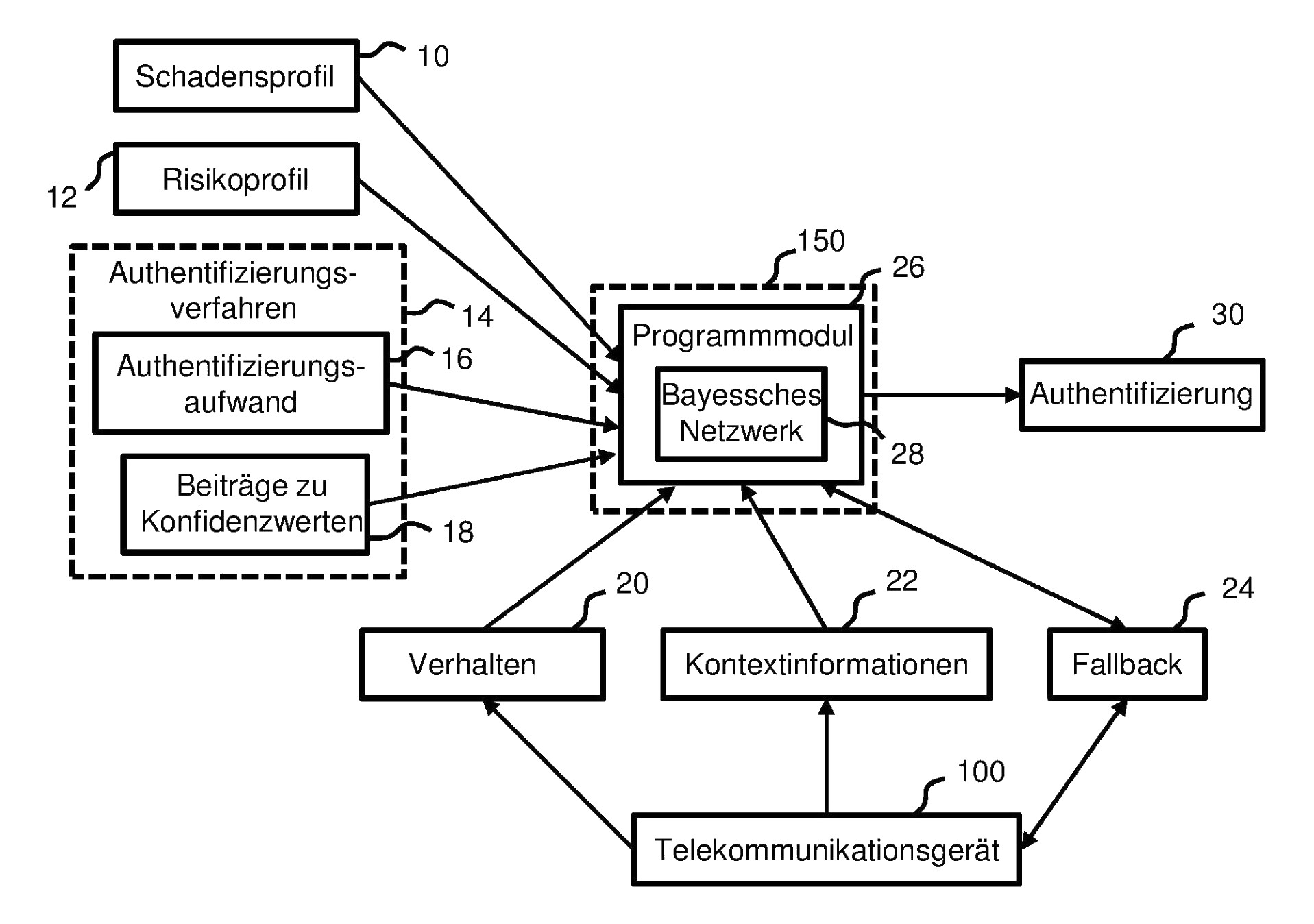
The overview at the top of this page (Fig. 1 of the patent) shows the architecture. A program module with a Bayesian network combines a damage profile, a risk profile and the available authentication methods, each with its effort and its contribution to the confidence in the user’s identity. The mobile device adds the user’s behaviour, context information and fallback options. From this, the network decides which authentication is required.
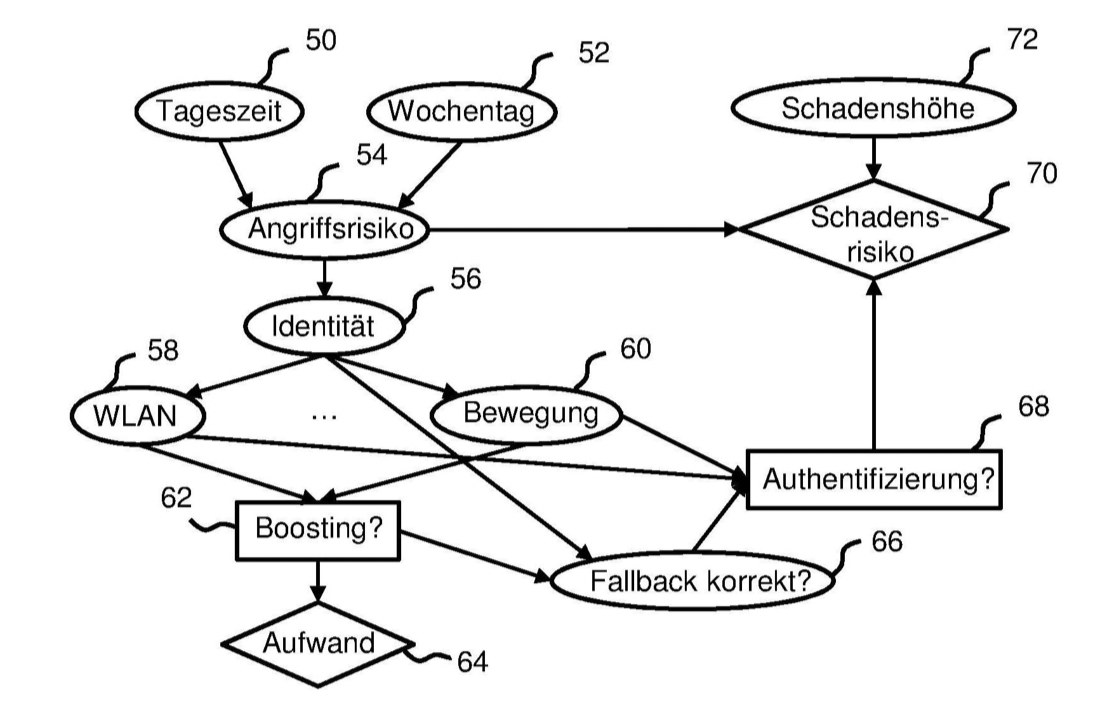
The mechanism is protected as German patent DE102018114961 and international application WO2019243474A1 (Automatisches adaptives Kalibrieren von Authentifizierungsanforderungen, published 12 December 2019). It is an example of the explicit representation of uncertainty in decisions, one of the threads of my research on validity and uncertainty.