
Enhancing Ontologies with LLMs
A semi-automated approach to keeping domain ontologies up to date
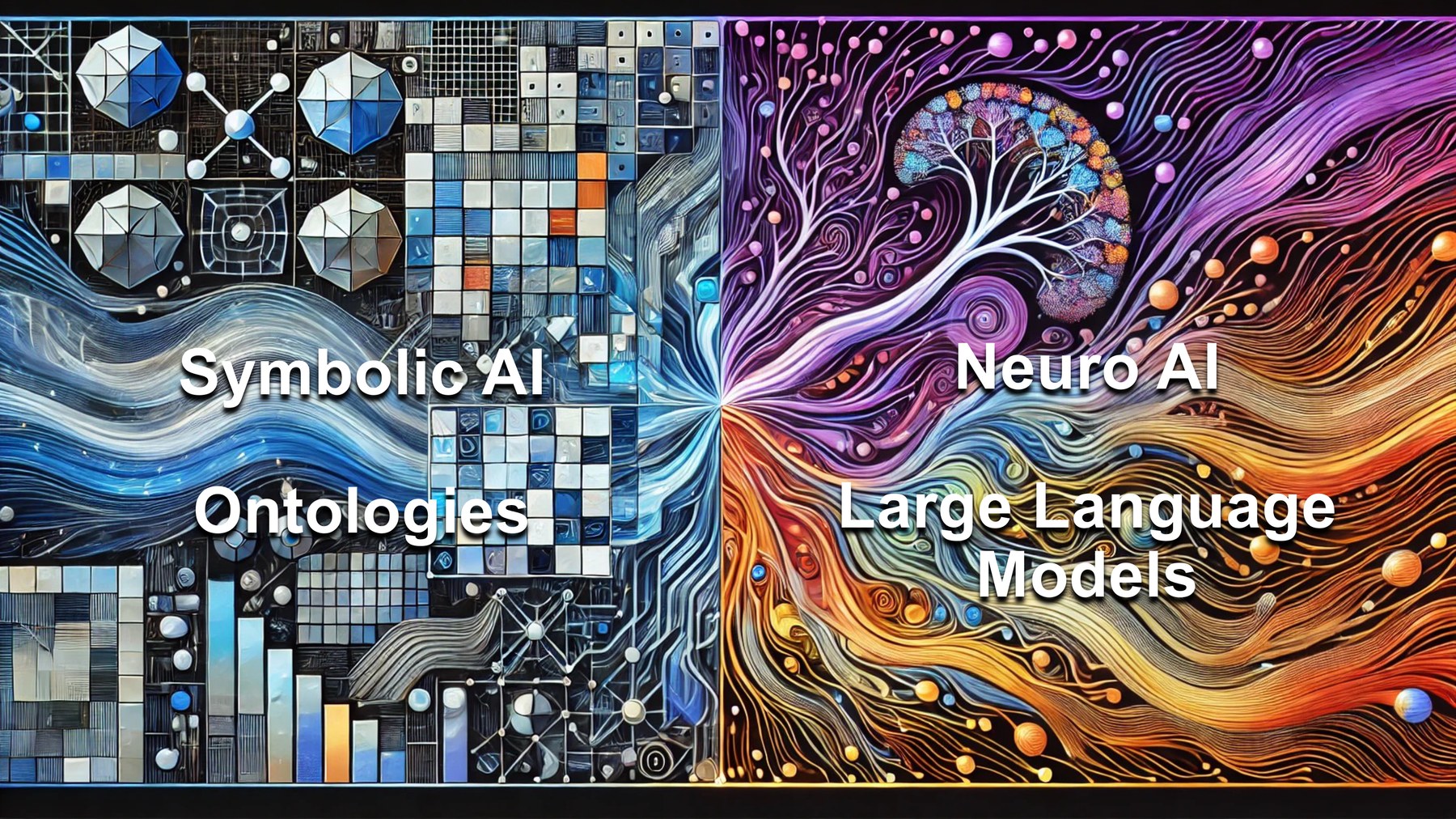
Ontologies bring symbolic AI and neural AI together: they provide the explicit, curated structure that large language models lack, and language models can in turn help ontologies keep pace with a changing field. This project explores that second direction.
The challenge

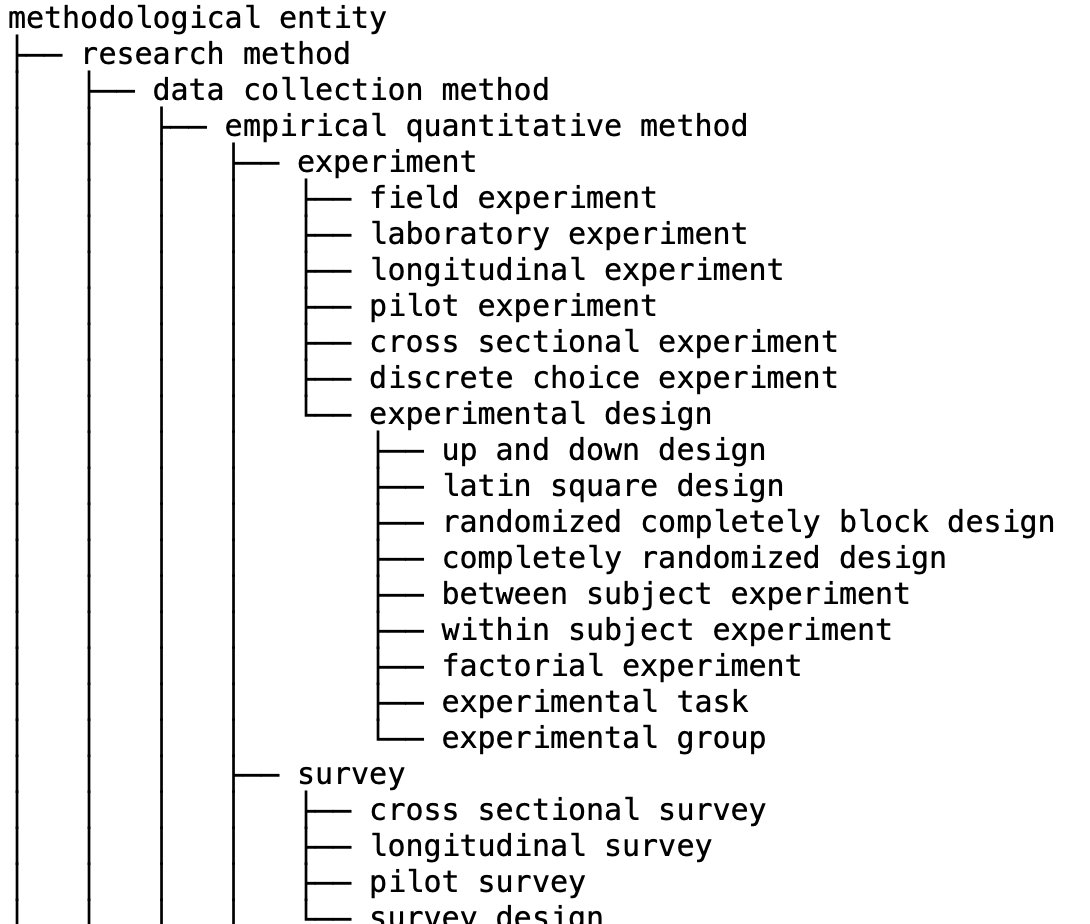
Ontologies describe the types of objects in a domain, their characteristics and how they relate. Examples range from SNOMED CT in medicine, with more than 357,000 concepts, to the Gene Ontology in biology and the Information Systems Ontology, which covers the theories, topics, technologies and research methods of the IS discipline.
But domain knowledge is dynamic and new terms appear constantly. Keeping an ontology up to date is traditionally manual, error-prone and time-consuming: experts analyse the ontology, identify gaps and add new entities and relations by hand. Aligning and merging ontologies automatically still requires substantial manual validation.
Our research question: How effectively can large language models support the enrichment of ontologies?
A semi-automated approach
Enriching an ontology with a new term involves two decisions: is the term a synonym of an existing entity, or a new concept? And if it is new, where does it belong in the hierarchy? We combine fine-tuned language models for both decisions with a final expert review:
Determine whether a new term is synonymous with an existing entity or a potential new entity.
Find the correct position for new candidate entities within the ontology's hierarchy.
Experts review the model outputs and make the final decisions.
All experiments use data from the Information Systems Ontology: 389,139 synonym pairs and 3,864 parent-child pairs. The pair participant → individual participant, for example, encodes a hierarchical relation, while individual participant ≈ worker encodes a synonym.
Step 1: Synonym identification
A fine-tuned Sentence Transformer (all-mpnet-base-v2) embeds the new term and every existing entity in the ontology.
The entity with the highest cosine similarity to the new term is selected.
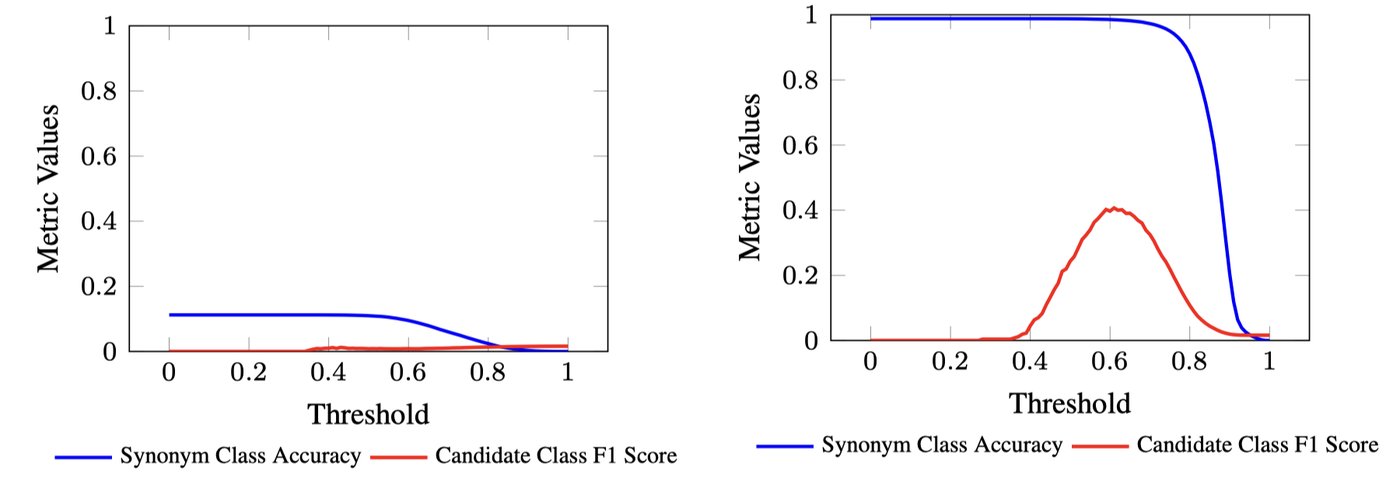
Score above 0.61: the term is classified as a synonym. Below: it is flagged as a candidate for a new entity.
The model was fine-tuned with a Multiple Negatives Ranking loss, in which every other pair in a training batch serves as a negative example. The threshold was chosen on a validation set across the full range from 0 to 1. Fine-tuning made the decisive difference: the base model mapped only about 11% of the terms correctly.
Step 2: Parent-child relationship identification
Because a whole ontology does not fit into a language model’s context window, placement is framed as a binary classification: given two entities, is the first a child (“is-a”) of the second? As negative examples we used nephew-uncle pairs, entities that share a grandparent without being parent and child, so the model learns subtle distinctions. We fine-tuned BERT and MPNet sequence classifiers.
| Metric | BERT | MPNet |
|---|---|---|
| Accuracy | 0.694 | 0.754 |
| Precision | 0.770 | 0.731 |
| Recall | 0.566 | 0.793 |
| F1 score | 0.650 | 0.759 |
MPNet is the more balanced choice when missing true relations is costly; BERT’s higher precision suits applications where every proposed relation must be correct.
Results
Language models are highly effective at matching synonyms. Recognising genuinely new concepts is harder (42% in our tests), and hierarchy placement reaches a moderate level. This is why we propose a hybrid workflow: LLMs match synonyms automatically and flag candidate terms, which experts then review. Adjustable thresholds let curators tune the balance to their priorities.
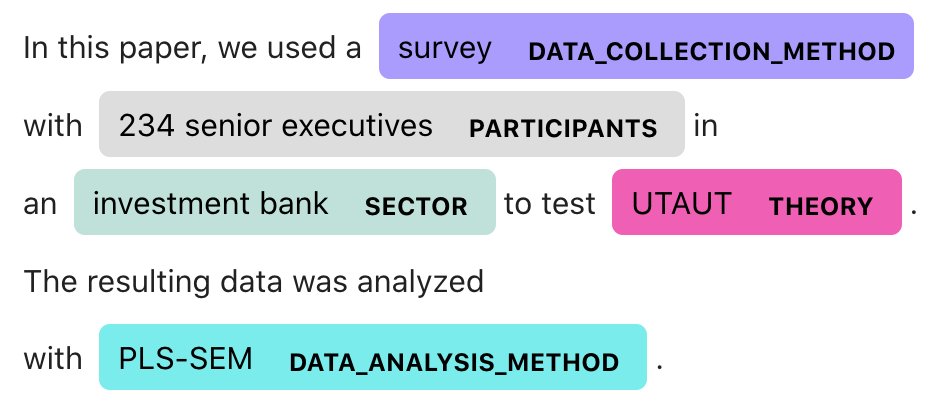
Better-maintained ontologies directly improve tools such as SemanticIS and the knowledge synthesis dashboard. Next steps include richer, domain-specific training data, context for entity pairs, and a broader range of language models.
Joint work with Anh T. V. Pham and Sebastian Hüttemann (HWR Berlin), presented at the 58th Hawaii International Conference on System Sciences (HICSS 2025).