
Information Systems Ontology
A machine-readable vocabulary of the theories, methods and topics of IS research
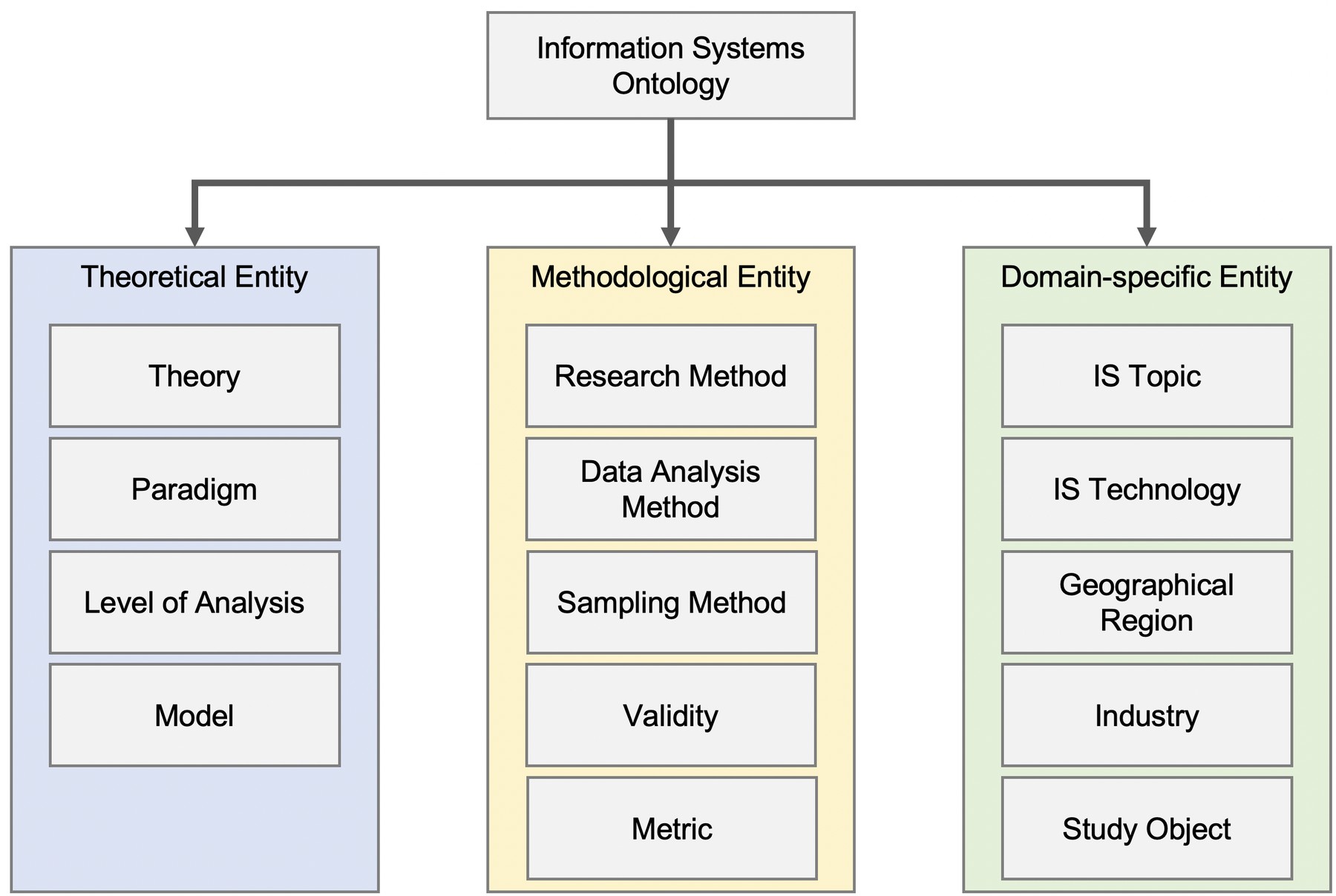
The number of scientific publications grows exponentially, and keyword search no longer keeps up. In Information Systems, a “case study”, “TAM” or “design science” carries a precise meaning, and the same concept appears under many names: the technology acceptance model, TAM and Davis’ model refer to one theory. General-purpose search tools miss these distinctions, so literature searches remain noisy and incomplete.
With Sebastian Hüttemann, Kai R. Larsen, Sen Yan and Abram Handler, I developed the Information Systems Ontology, an explicit, machine-readable specification of the theories, methods and topics of IS research. Its goals: move beyond keyword search, enable the automatic annotation of papers, improve the search for academic articles, and support knowledge synthesis. We presented it at DESRIST 2022.
Three main branches
The ontology organises IS research into theoretical, methodological and domain-specific entities (see the diagram at the top of this page). Some examples:
| Branch | Entity | Examples |
|---|---|---|
| Theoretical | Theory | information systems theory, social sciences theory, management theory, economic theory |
| Research paradigm | realism, pragmatism, positivism | |
| Level of analysis | macro, meso and micro level | |
| Model element | construct, variable | |
| Methodological | Research method | design science, simulation, case study, experimental design |
| Data analysis method | triangulation, synthesis, machine learning, descriptive statistics | |
| Sampling method | purposive sampling, critical case sampling, bootstrap sampling | |
| Statistical metric | goodness of fit, standard deviation, mean squared error | |
| Validity | diagnostic validity, construct validity, design validity | |
| Domain-specific | IS topic | knowledge management, business process management, gamification |
| IS technology | social media, mobile systems, semantic web, ubiquitous computing | |
| Geographic name | Europe, Western Europe, United Kingdom, London | |
| Economic sector | manufacturing, chemical industry, pharmaceutical industry | |
| Study object | start-up, SME, individual, group or organisational participant |
How it was built
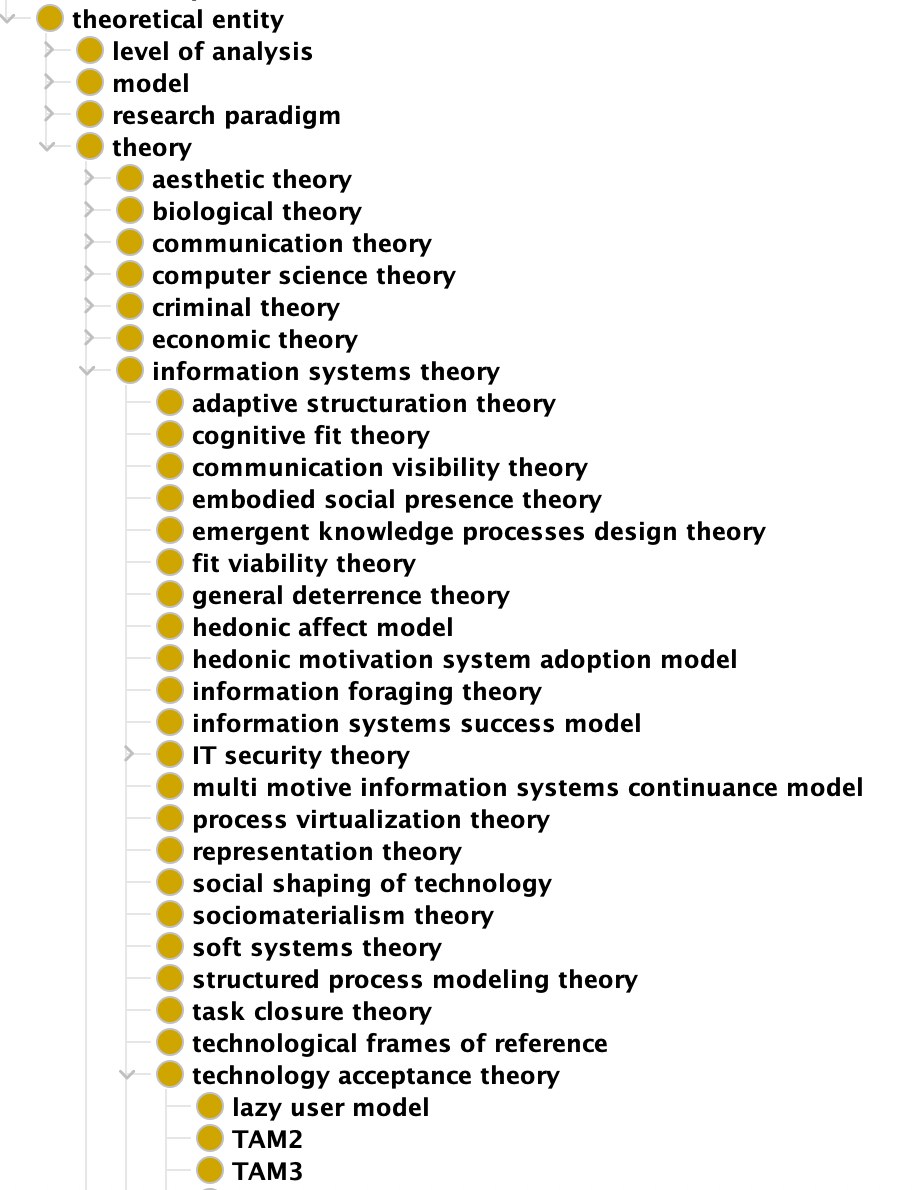
We combined a classical ontology-building method with text mining in five steps:
Initial hierarchy following the ontology-building method of Arp et al. (2015), based on standard textbooks and discussions among the authors.
Manual analysis of 150 articles from the AIS Basket of Eight to identify entity candidates and synonyms.
Automated identification of entity candidates with linguistic patterns, for example "theory of …".
The most frequent scientific terms in 7,304 Basket-of-Eight articles; manual screening of about 2,000 candidates.
Comparison with the IS classification schema of Barki et al.; screening of about 1,000 further candidates.
Evaluation
To test coverage, we extracted the 13,987 author-defined keywords of the 7,304 articles and checked how many of them each vocabulary contains, compared with three established classification schemes: the Computer Science Ontology (Salatino et al. 2018), the IS keyword classification scheme of Barki et al., and the ACM Computing Classification System (ACM CCS):
| Vocabulary | All keywords | Top 1,000 keywords | ||
|---|---|---|---|---|
| IS Ontology | 1,830 | 13.1% | 456 | 45.6% |
| CS Ontology | 726 | 5.2% | 170 | 17.0% |
| Barki et al. | 384 | 2.7% | 129 | 12.9% |
| ACM CCS | 239 | 1.7% | 75 | 7.5% |
The IS Ontology covers more than two and a half times as many of the most frequent author keywords as the next-best vocabulary.
What it enables
The ontology is the backbone of a whole family of tools:
- SemanticIS uses it to detect domain-specific terms in the full text of more than 57,000 research articles and offers them as semantic search filters.
- The knowledge synthesis framework and its dashboard use it to map research fields, identify research gaps and analyse trends.
- Enhancing Ontologies with LLMs keeps the ontology up to date: fine-tuned language models identify synonyms with 98% accuracy and propose where new terms belong in the hierarchy (HICSS 2025). Students in the Text, Web and Social Media Analytics Lab apply the same approach.
- The ITEM Ontology for survey indicators recommends it for extending its information-systems entity.
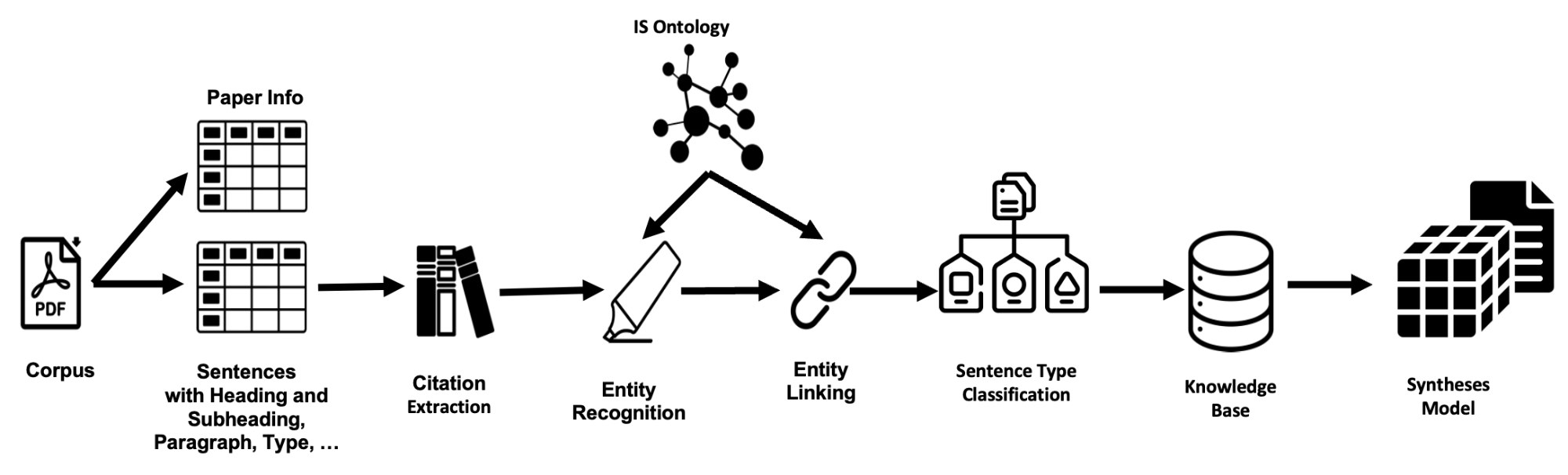
In all of them, research articles pass through the same pipeline. The PDFs of a corpus are split into paper information and sentences, together with their headings, paragraphs and types. Citations are extracted, and entity recognition and entity linking find the terms of the IS Ontology and connect them to its entities. A sentence-type classifier keeps the terms that describe the article itself rather than related work, and the results are stored in a knowledge base from which syntheses of whole research fields are built.
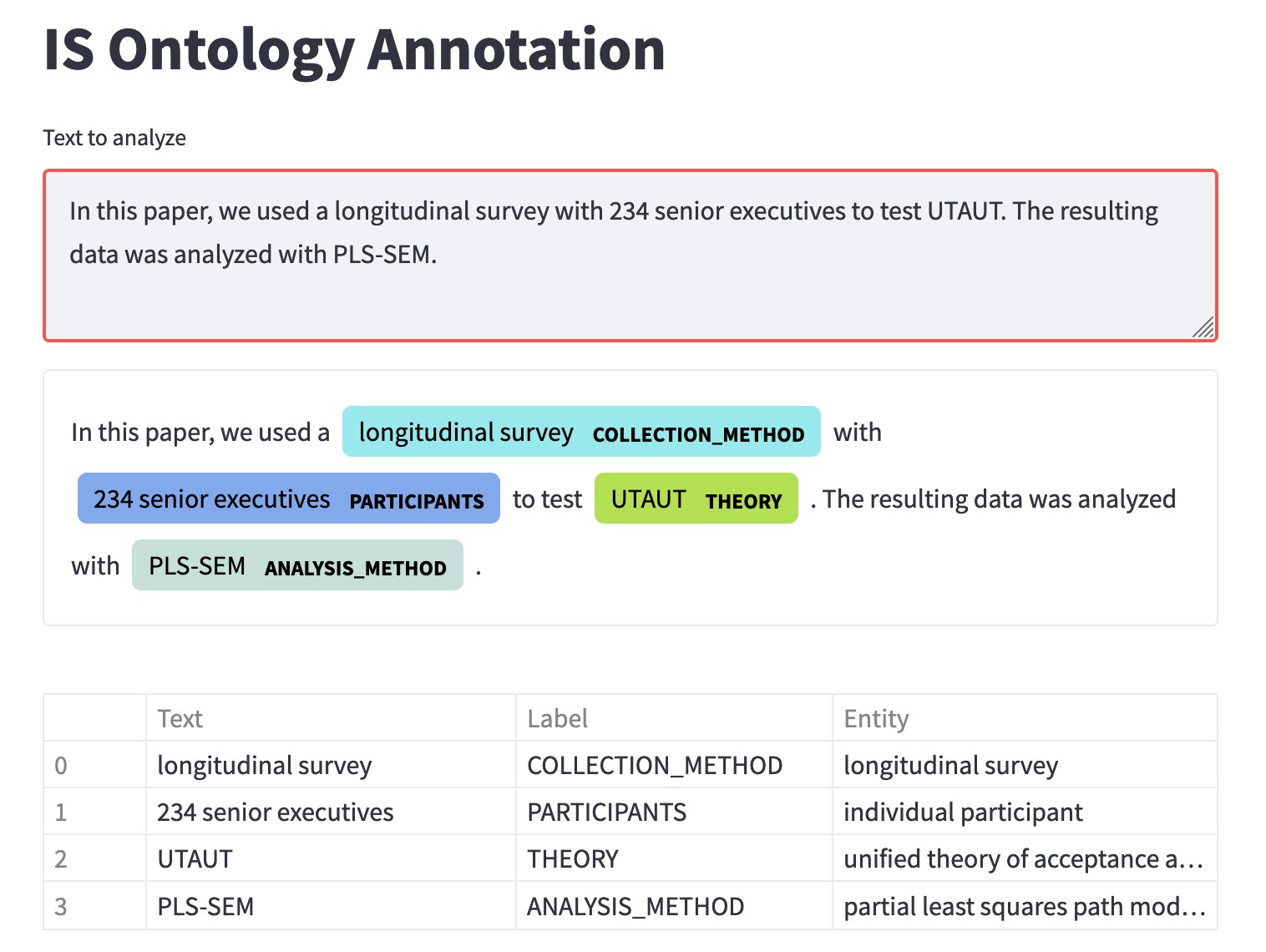
Because each term is grounded in an explicit vocabulary, the results can be traced back to the exact sentences in which they appear. This is a key difference from purely generative approaches and a building block of my research on knowledge extraction with explicit representations.