
Futures Methods for Design Science
Designing and evaluating future-oriented artefacts with experts and AI
How do you design for a future that nobody knows? Information systems are built today for a world that will look different tomorrow. Many futures are possible, some are plausible, a few are probable, and some are preferable. Technologies may not be ready yet, and the future users cannot be asked.
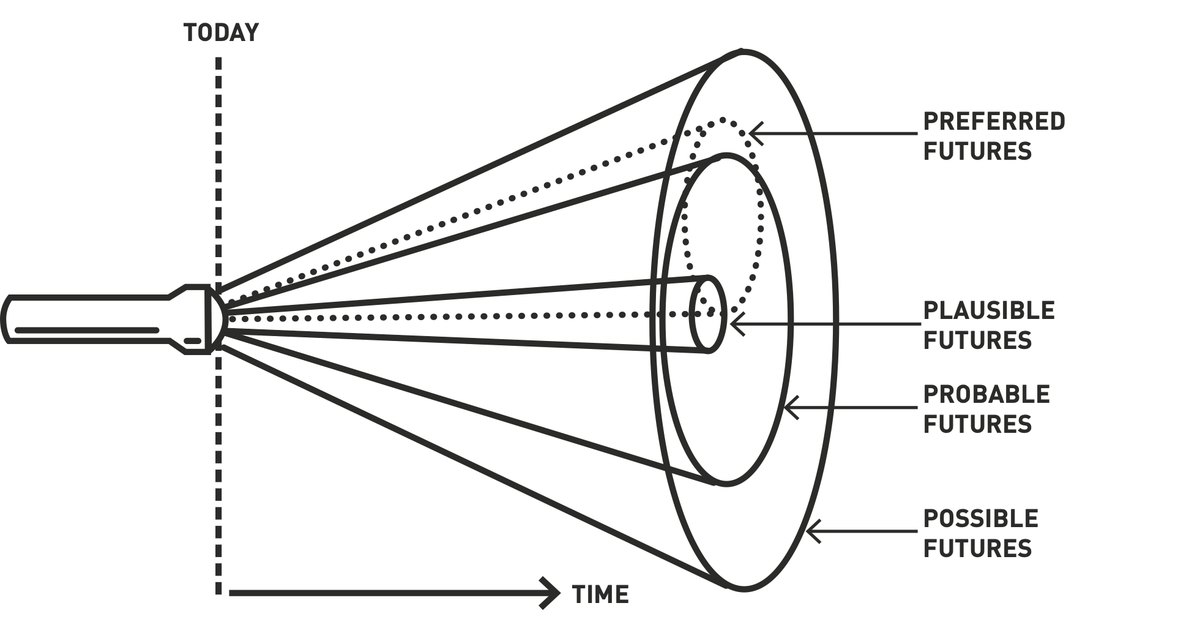
Futures research has followed two typical approaches (Hovorka & Peter, 2019). Scientific, expert-led methods such as forecasting, scenario methods and the Delphi method confirm future scenarios but rarely produce new artefacts. Speculative, design-led approaches such as critical design, design sprints and science fiction create new artefacts but are less rigorous. With Katja Thoring, Hermann W. Klöckner, Kai R. Larsen, Caroline V. Rudzinska, Susanne Dreyer and further colleagues, I develop design science methods that bring both together. Each section below presents one of them.
1 · The Delphi Design Sprint
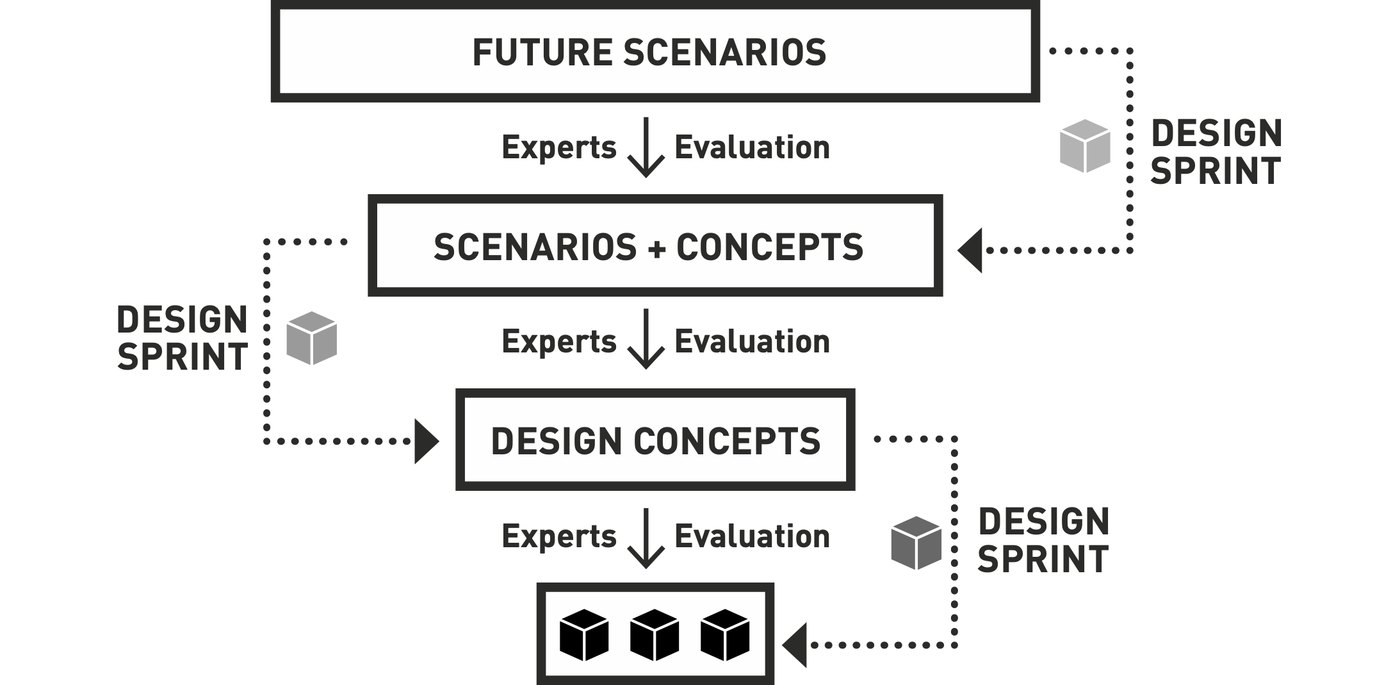
The Delphi Design Sprint combines the classic Delphi method, in which an expert panel evaluates and refines future scenarios over several rounds until it reaches consensus, with design sprints, which develop and test ideas in short, intensive cycles. Scenarios and design concepts are developed in alternation: experts evaluate the scenarios, designers develop concepts for them, and experts evaluate the concepts again.
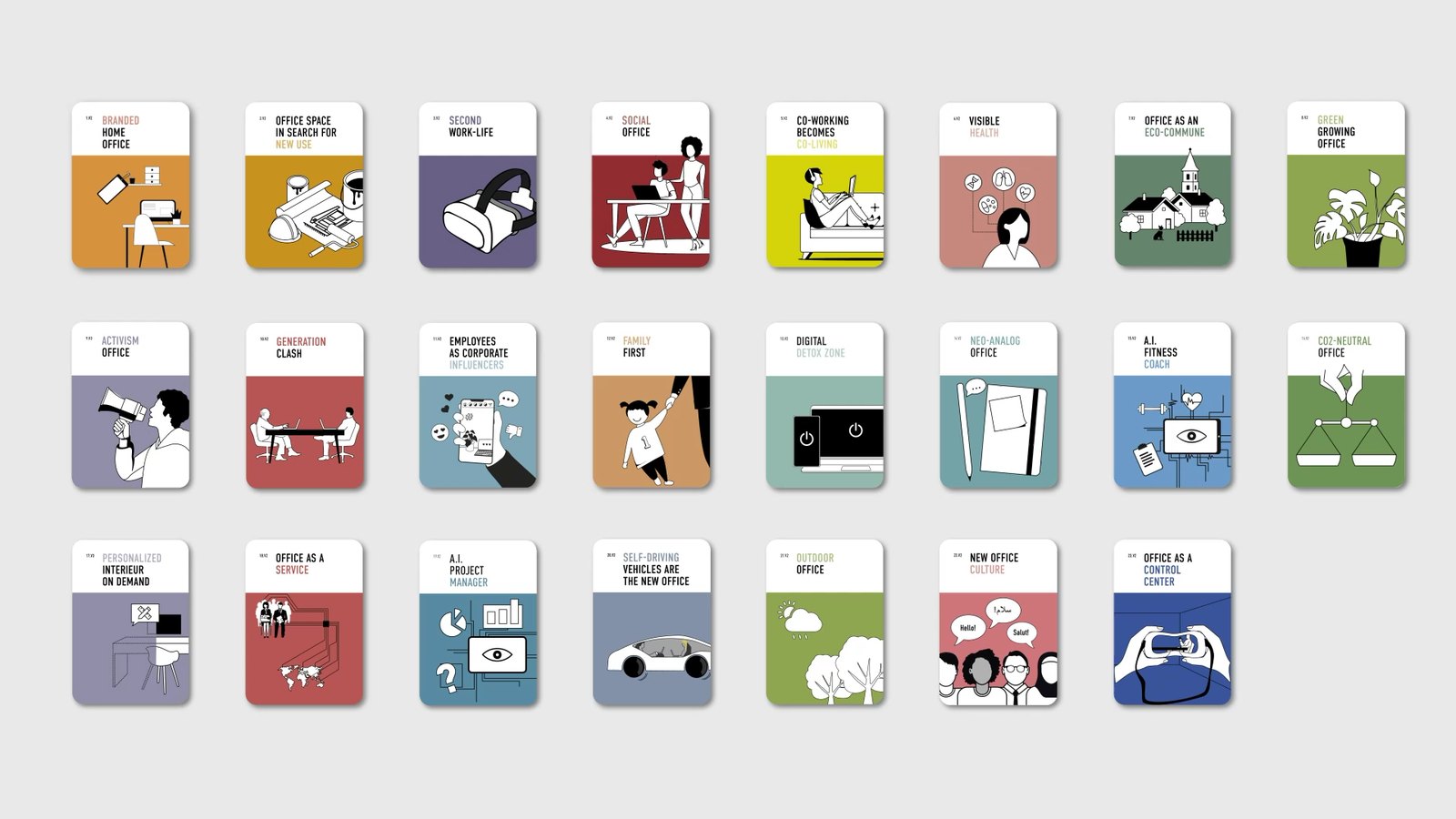
We developed and tested the method through action research in the project The Office of the Future in the master’s programme Integrated Design at Anhalt University in Dessau: design concepts for the office after Covid-19, the office for Generation Z, and the impact of emerging technologies on the office. A panel of 20 international experts from technology, office planning, office research, futurology and science fiction accompanied the project. From 30 initial ideas, the team developed 23 future scenarios:
In three design-sprint rounds, the team developed concepts for selected scenarios, from quick concept napkins to prototypes, each rated by the experts. Four rounds of expert evaluation and a concluding workshop converged on 23 final scenarios and 9 future artefacts, from a Digital Office Twin and an AI Mood Coach to a Foldable Home Office Cabin and the Intelligent Desk.
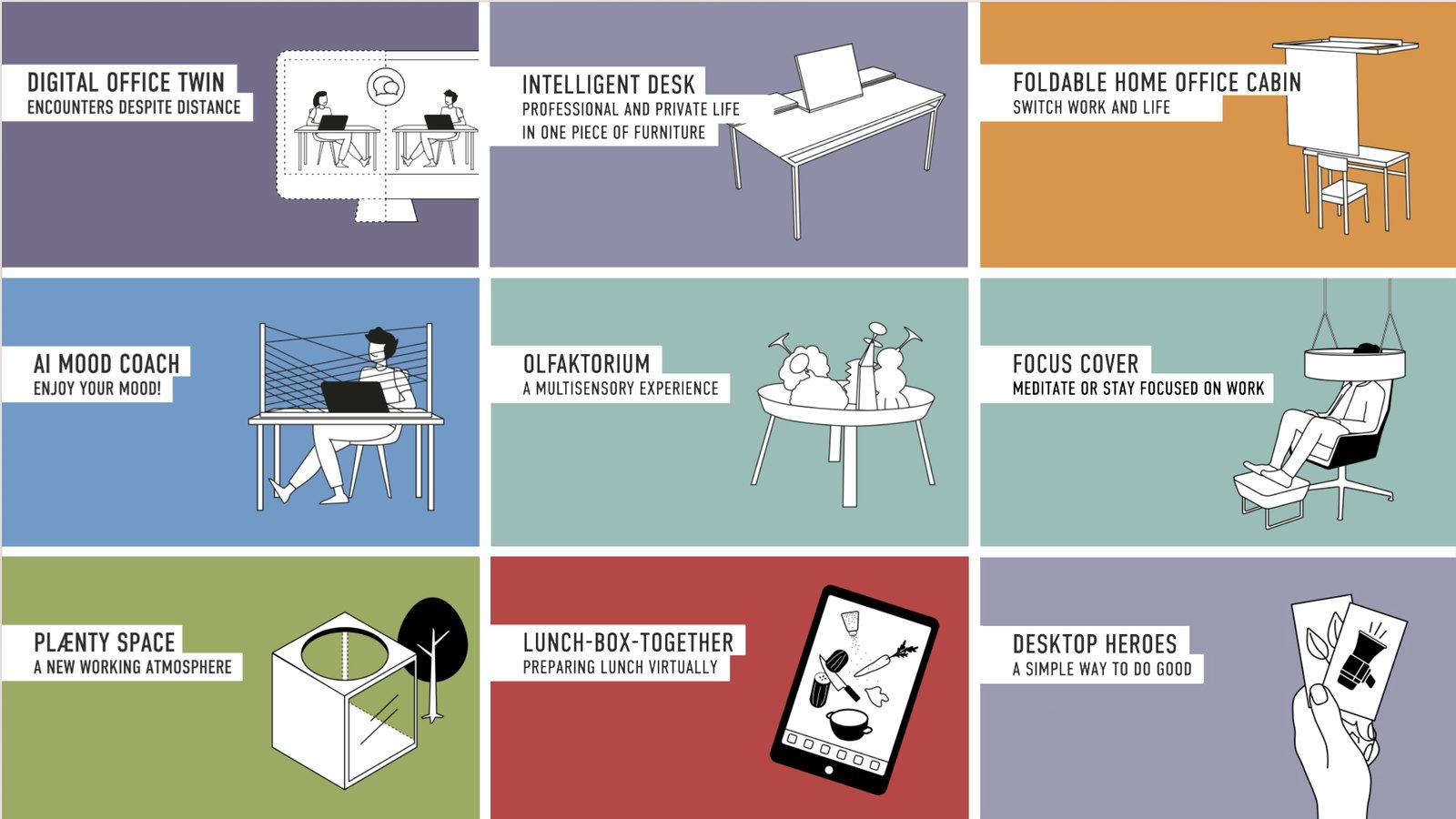
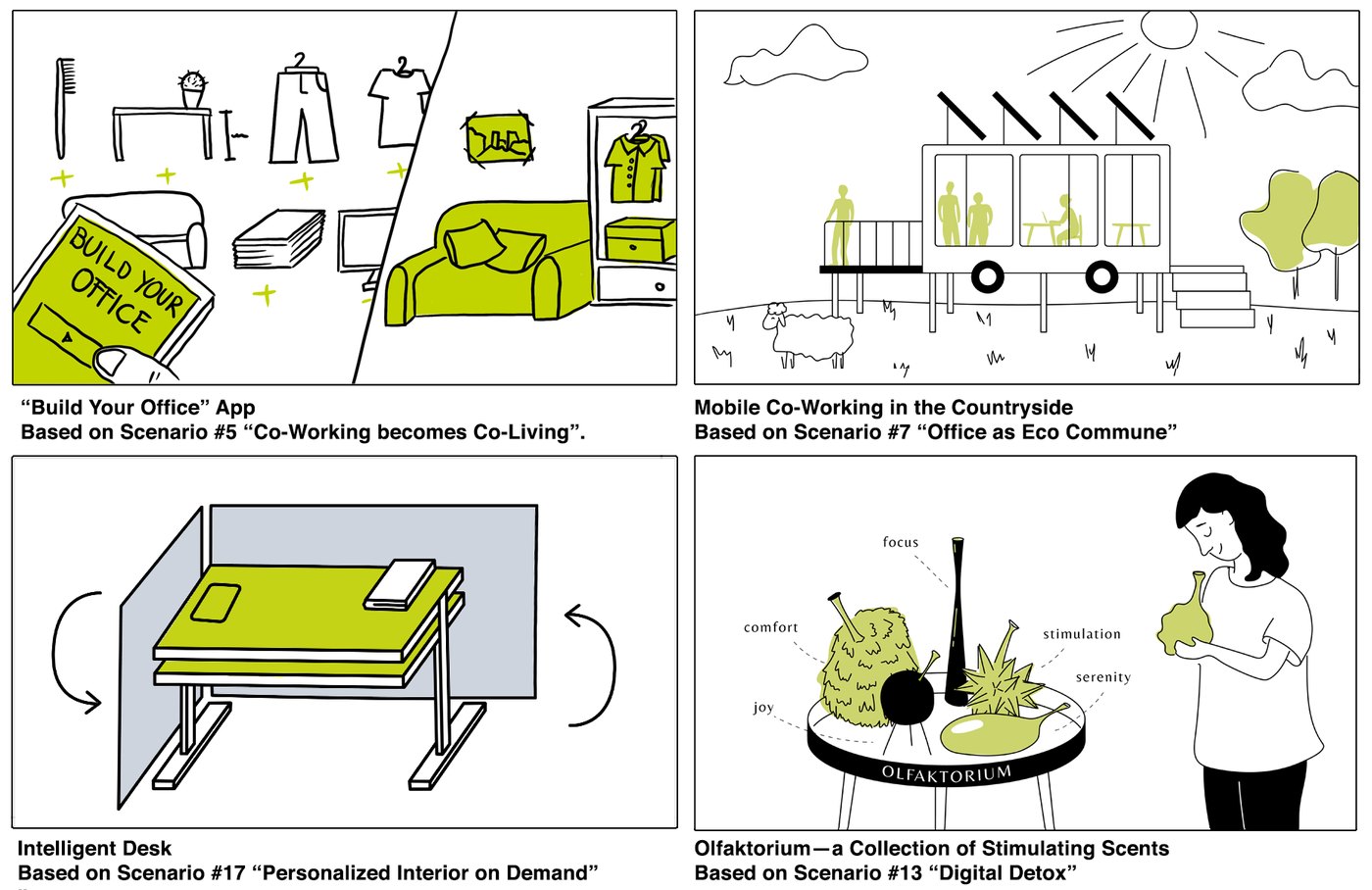
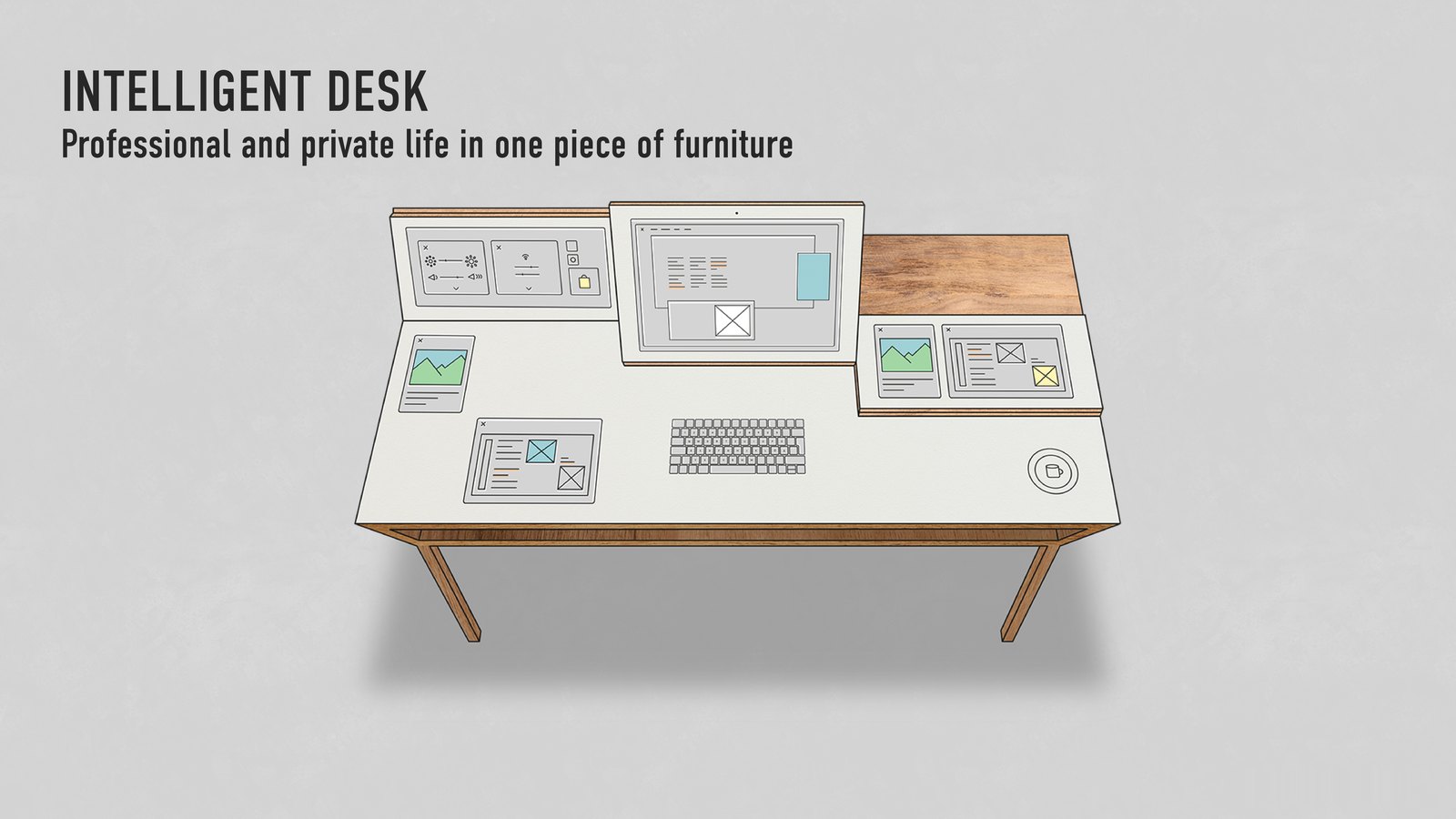
Actionable advice: recruit a multidisciplinary expert panel; develop and validate scenarios through online questionnaires; develop design concepts in internal design sprints and validate them with the experts; conclude with a joint workshop. Keep experts anonymous until the workshop to mitigate bias, allow asynchronous participation, invite quantitative and qualitative feedback, and keep all concepts in a consistent format to ensure comparability.
2 · The FOD framework for future-oriented design
Future-oriented design follows one of two strategies. Futuristic design creates realistic artefacts for a near future that is not yet possible, because the technology is not ready or the context has not yet occurred; such artefacts can become radical innovations. Speculative design creates “artefacts from the future” that engage today’s audiences with possible futures, as material for discussion, for example to create preferred futures or prevent undesired ones. But how can such artefacts be developed and evaluated if their users and context do not exist yet?
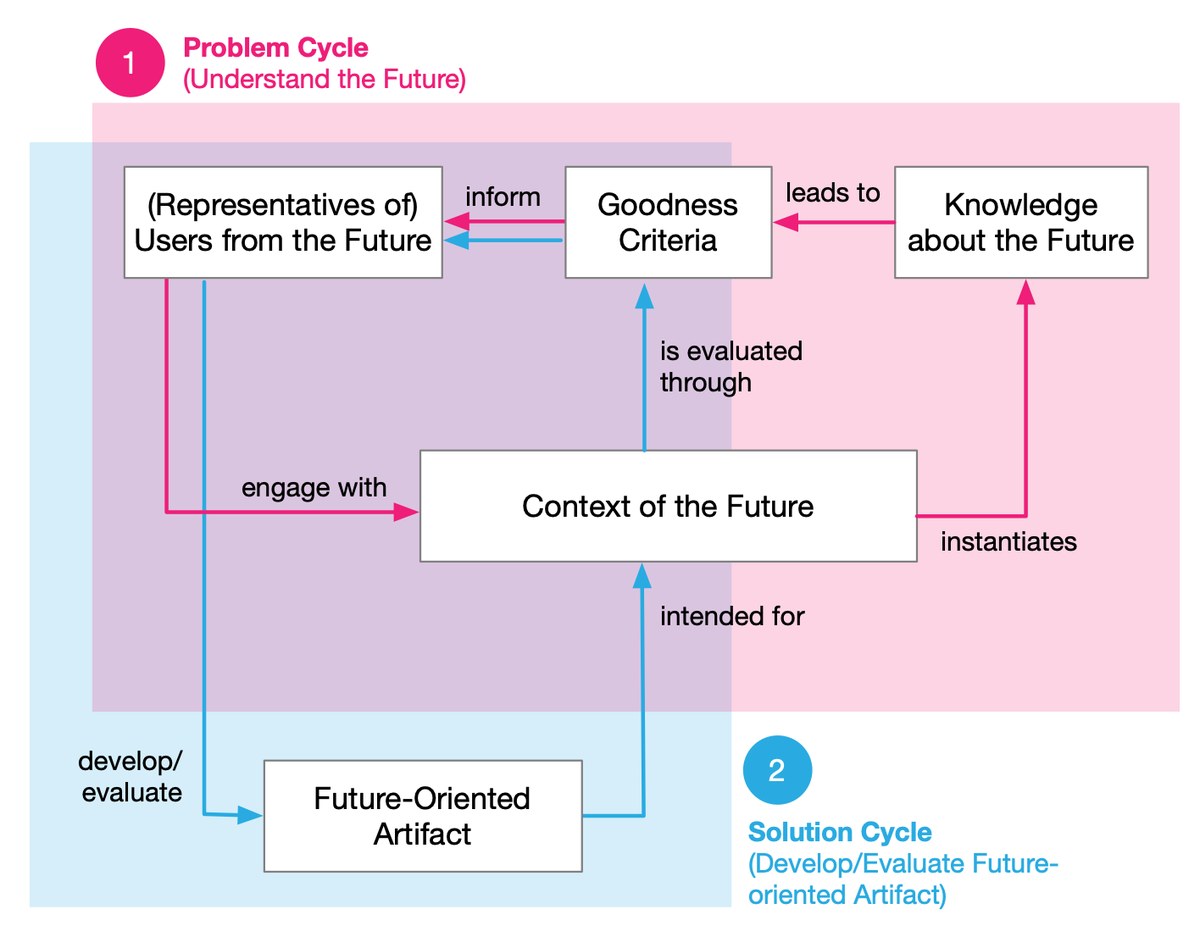
The FOD framework answers this with a process model of two interlinked cycles. In the problem cycle, knowledge about the future instantiates a context of the future, which informs goodness criteria and the (representatives of) users from the future. In the solution cycle, the future-oriented artefact is developed for this context and evaluated with these users and criteria. The process model is shown at the top of this page.
A morphological box spans the design space along eight dimensions: the type of artefact, knowledge about the future context, the representatives of future users (futurologists, technology experts, lead users, science-fiction authors), how to inquire the context of the future (role play, serious gaming, imagination, expert focus groups, living labs, simulation), the epistemic stance (design, predict, prevent, explore or explain the future), the design approach, and contextual and artefact-related goodness criteria. Mapping the Office of the Future project onto the box made its choices explicit, shown in yellow:
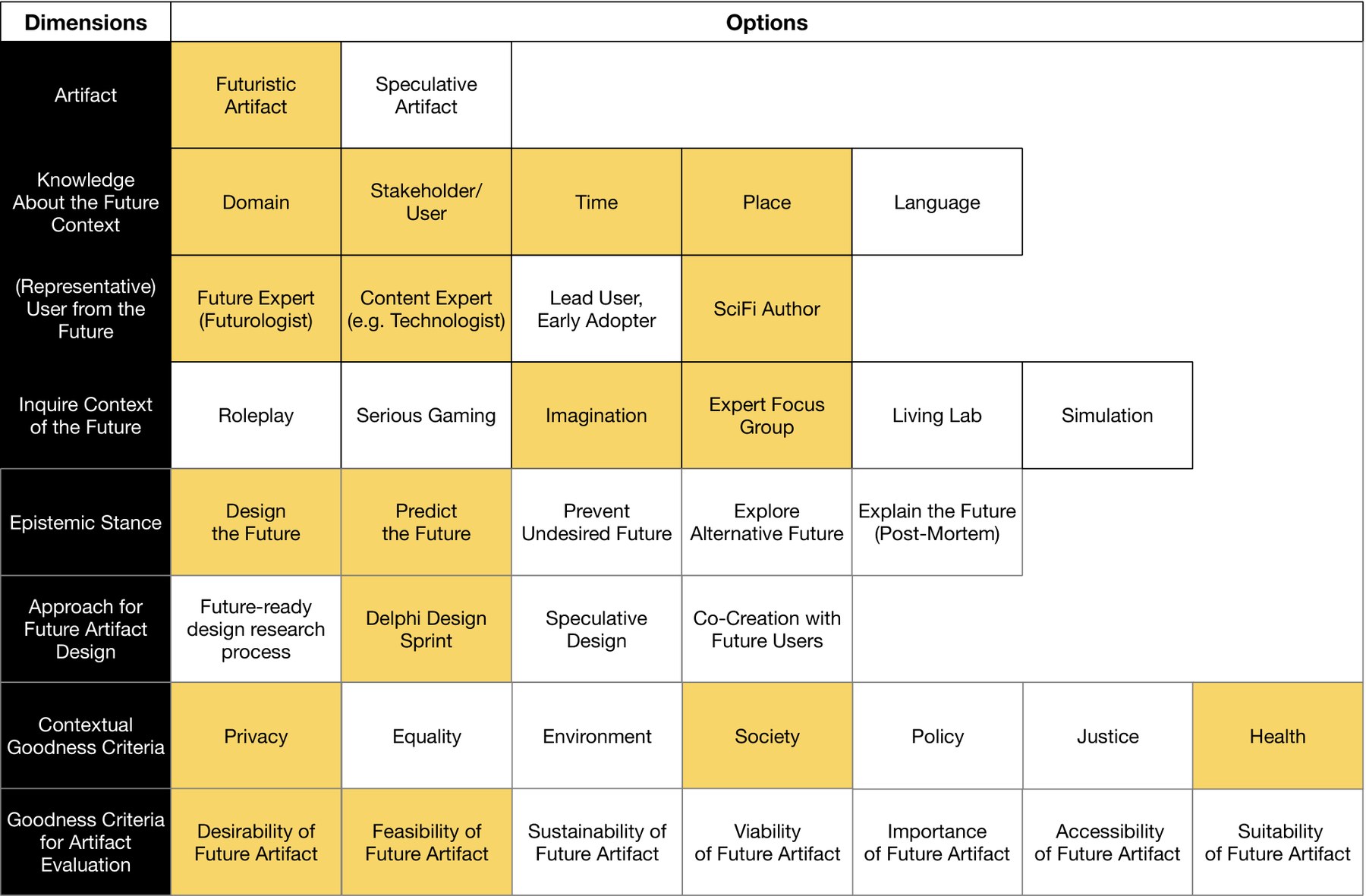
The mapping also showed what was missing. The expert panel worked well for developing scenarios and assessing feasibility, but desirability and the needs of future users were hard to judge, and experts contributed factual knowledge rather than empathy. Involving lead users, role play or bodystorming could close this gap.
3 · A hybrid Delphi panel with generative AI
Assembling a diverse expert panel takes a lot of effort. Can generative AI augment it? In early 2023 we repeated the Office of the Future Delphi panel with ChatGPT-4: twenty “AI experts”, each prompted with the expertise of one human expert, rated the same 23 scenarios, and twenty “AI digital twins” were prompted with detailed profiles of individual experts.
- Moderate agreement at panel level, but the AI panel was more extreme and more uniform (mean absolute rating 0.93 vs. 0.45; average standard deviation 0.47 vs. 1.13).
- Humans avoid harsh judgements: human experts voted “very unlikely” 41 times, the AI experts once in 420 votes, a hint of social desirability bias in Delphi studies.
- No digital twins: individual experts and their AI twins hardly agreed (κ = 0.12 across 433 pairs).
- Different feedback: humans commented rarely and briefly but asked reframing questions and suggested sources; the AI explained its ratings at length but questioned less. Asked for scenario variations, ChatGPT produced 30 new scenarios, ten of them rated “very innovative” by at least one researcher.
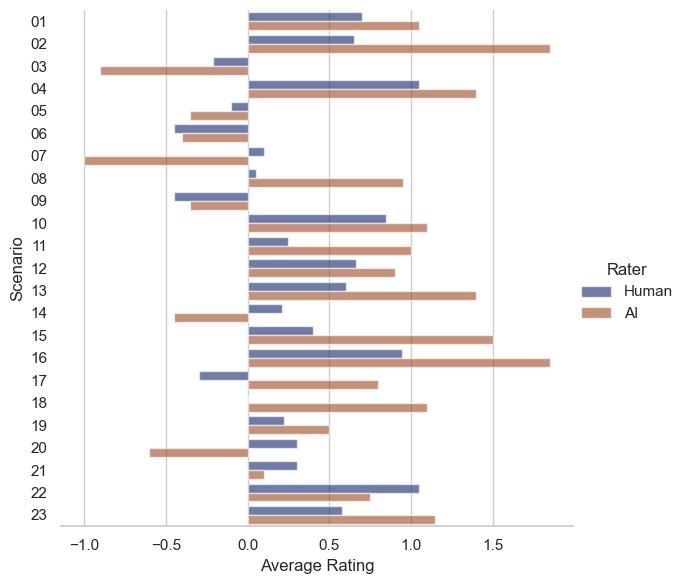
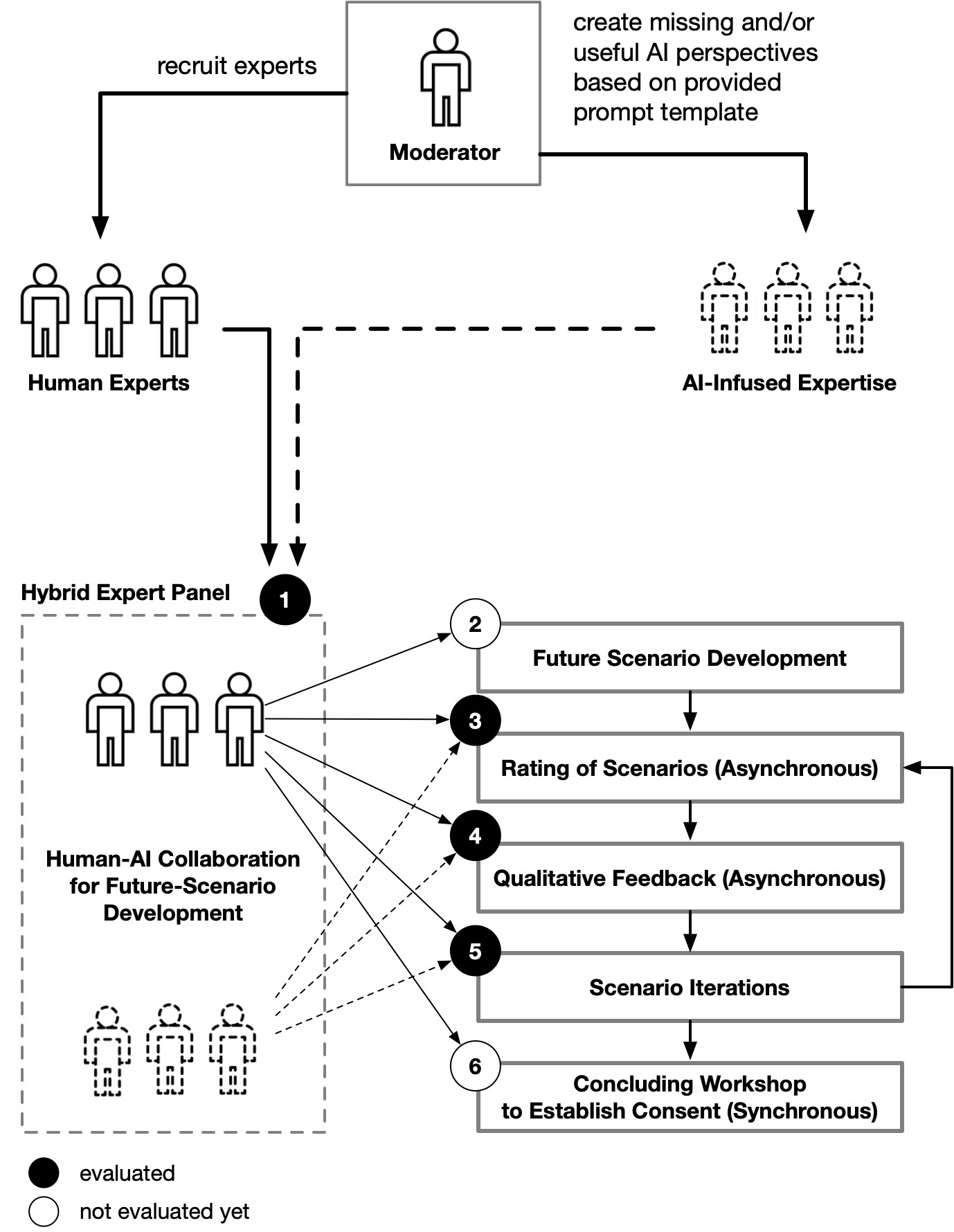
AI cannot replace individual human experts, but it can augment a panel with additional perspectives. We propose a hybrid Delphi process: a diverse panel of human and AI experts, independent ratings and feedback from both, iterated scenarios, and transparency about the AI’s contributions.
4 · Futures’ Fingerprints and AI-supported world-building
The latest line of work asks how groups, and groups with AI, can assess futures together and make them tangible. Three HICSS papers build on each other: a boundary object for joint scenario assessment, a dialectical AI sparring partner that trains futures literacy, and a method for AI-supported future world-building.
Futures’ Fingerprints: a round table for scenario assessment
Delphi studies work, but they take weeks, and the experts never really sit at one table. Futures’ Fingerprints (with Hermann W. Klöckner, Caroline V. Rudzinska and Jonah L. Schierding; HICSS 2025, Best Paper nomination) turns the futures cone into a digital round table. The concentric circles stand for possible, plausible and probable; each expert sits in one sector of the table, one for each STEEP perspective (social, technological, economic, ecological, political). Their upper and lower likelihood estimates are joined by smooth curves into a shared shape, the fingerprint of a scenario. Iso-probability lines show how much the experts agree, and the colour encodes how preferable they find the scenario, from red to green.
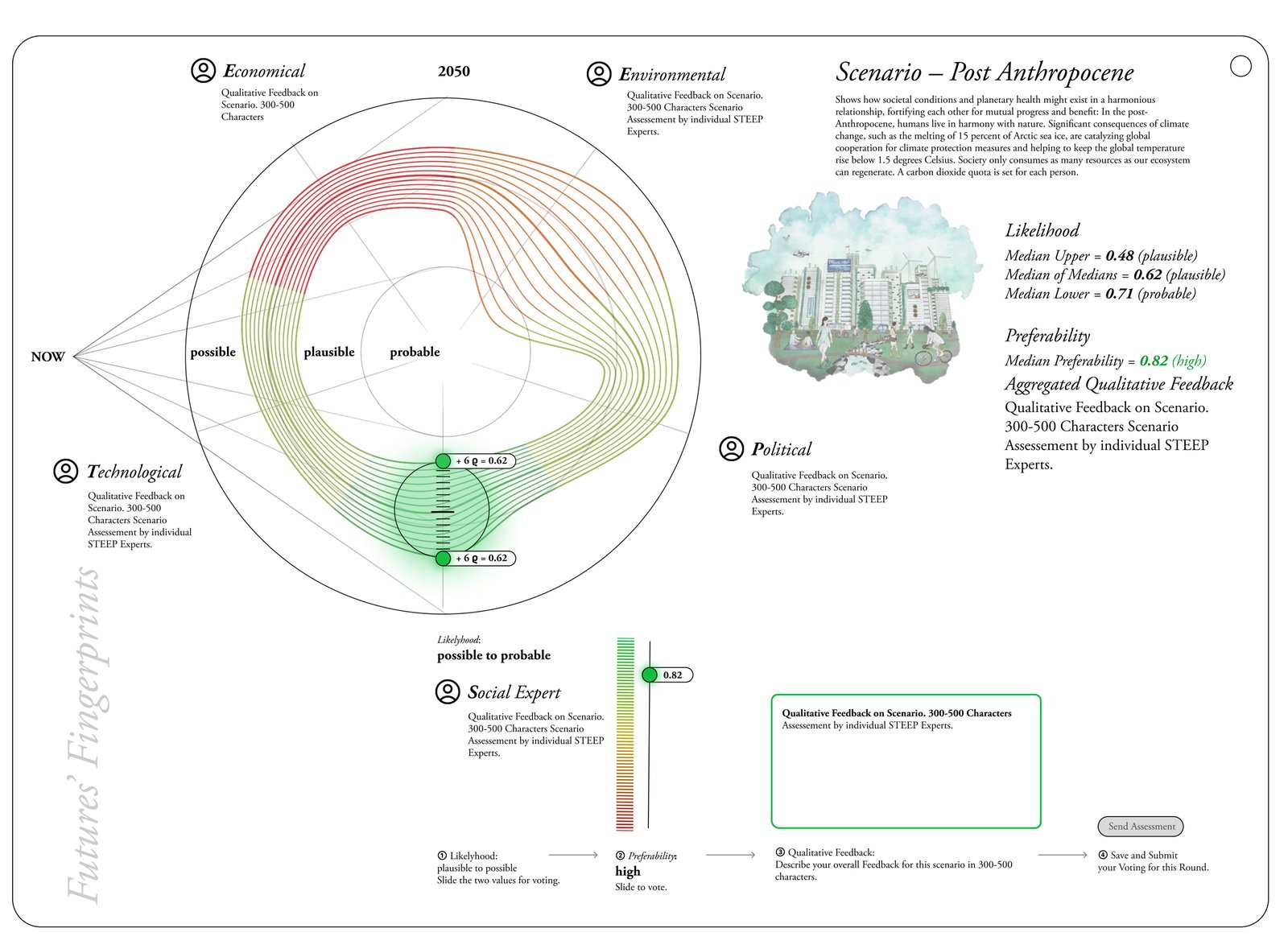
The interaction grows over three rounds. In the first, experts assess each scenario anonymously by drag and drop. In the second, they see the others’ fingerprints and anonymous written feedback, labelled with its STEEP perspective, and revise. In the third, identities are revealed and the group refines the shared fingerprint live in a video call. In the first study, five experts assessed ARUP’s four 2050 scenarios in 90 minutes instead of weeks. They described the experience as “inspiring”, “joint” and “respectful”, and singled out the tangible shifting of opinions. Their estimates converged visibly: the fingerprints became rounder, and the standard deviations fell in every round, for example from 0.22 to 0.10 for the upper likelihood of Extinction Express.
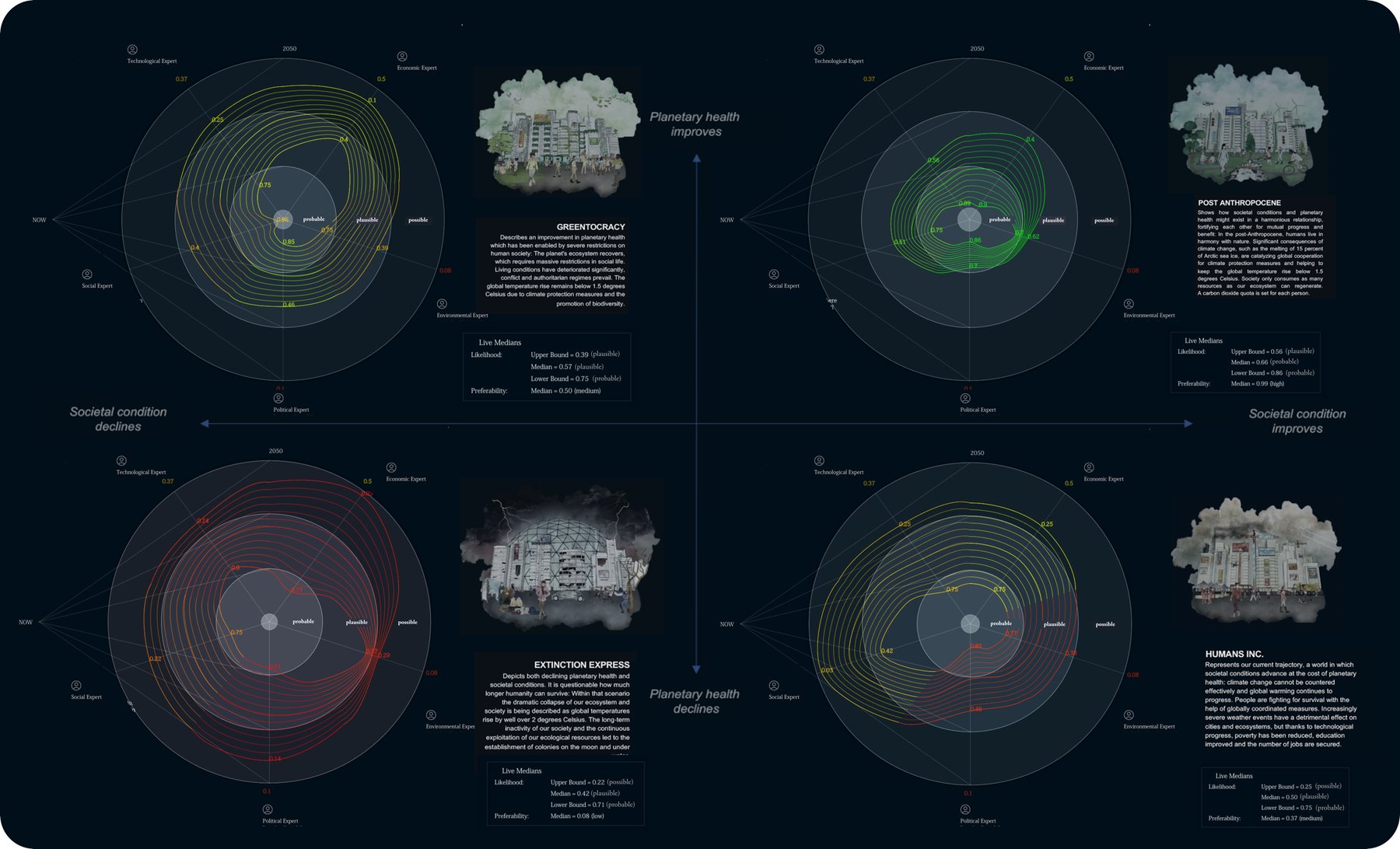
The exposé also shows where experts agree to disagree: all of them find Post Anthropocene highly preferable, but their likelihood estimates for Humans Inc. and Post Anthropocene spread widely. Convergence is the purpose of a Delphi study, but a persuasive shared visual may also push towards consensus. Is that always desirable? This question led to the next step.
Futures’ Fingerprints+AI: dialectical AI as a sparring partner
In Futures’ Fingerprints+AI (Rudzinska, Klöckner, Mueller & Schierding; HICSS 2026), every participant gets a dialectical AI sparring partner. The AI does not hand out answers. It challenges assessments, brings in counter-arguments and asks for reasons. Hybrid intelligence (human + AI) is combined with collective intelligence (human + human + human) around the fingerprint as a shared boundary object.
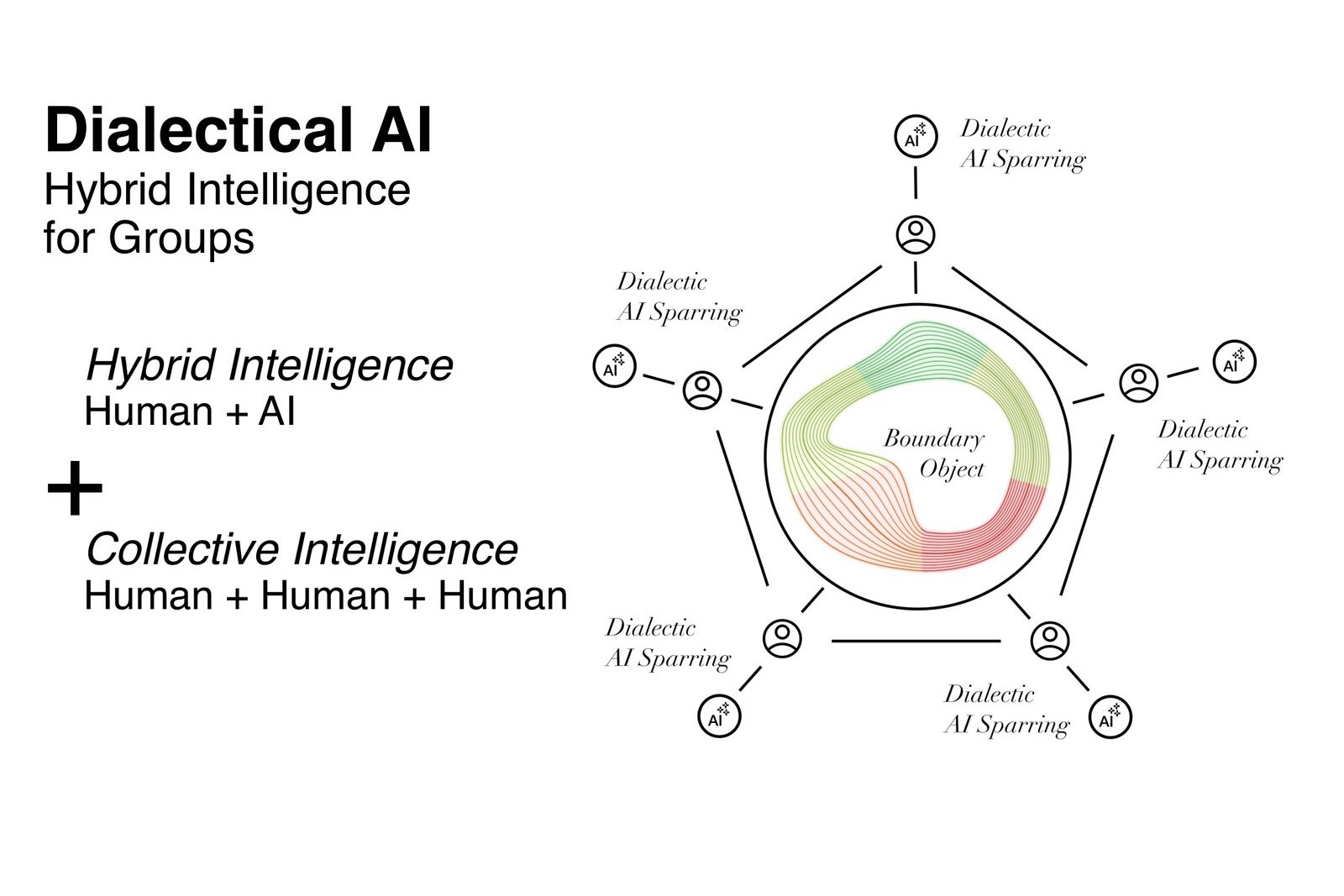
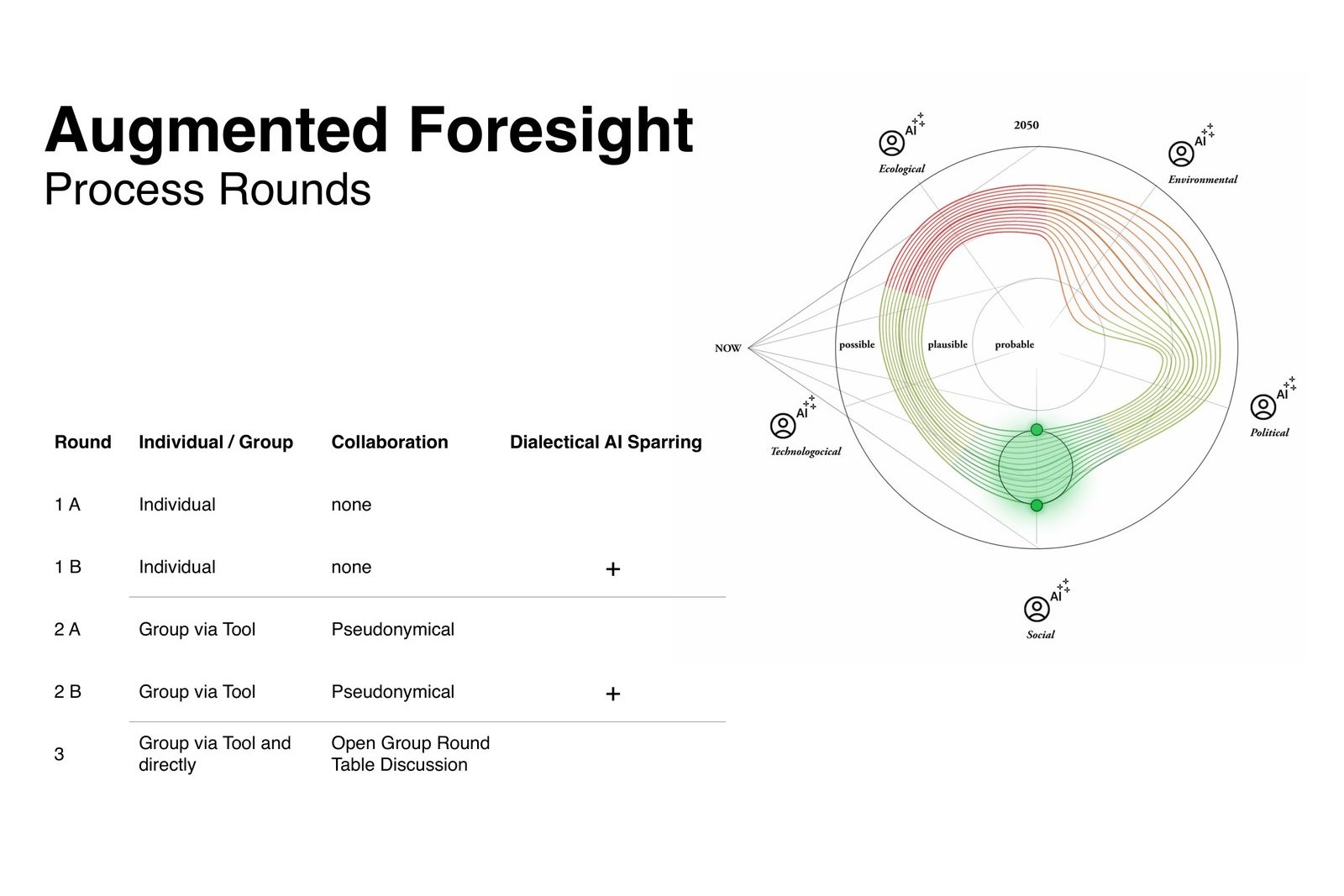
Each round is played twice, first without and then with AI sparring: individually (1A/1B), then as a pseudonymous group in the tool (2A/2B), and finally in an open round-table discussion (3). The scenarios are presented with text, images and video; participants can open the AI sparring panel for their own perspective at any time.
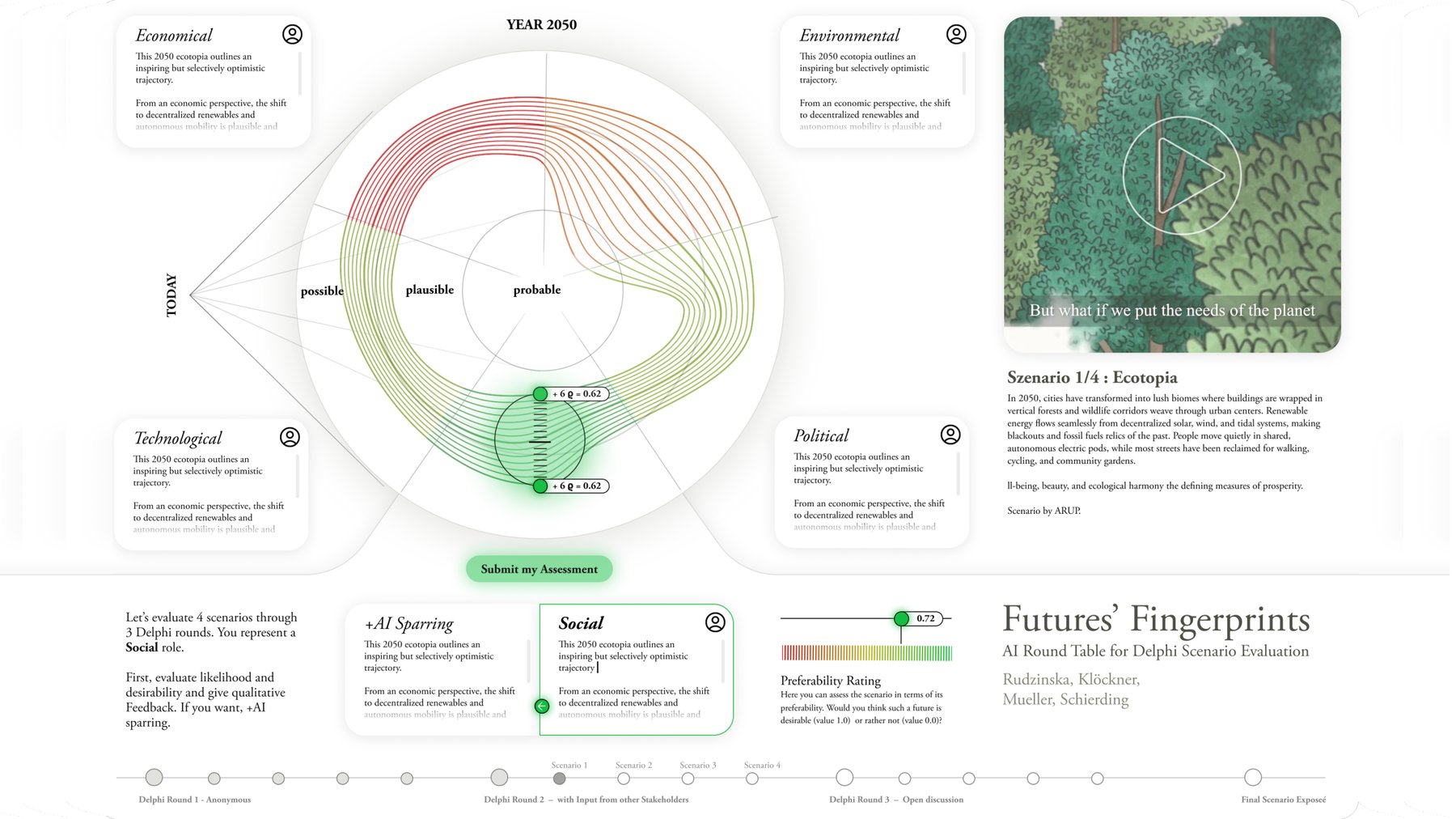
In a study with 42 students of an international innovation and foresight course, a Futures Literacy Test before and after the sessions showed an overall gain of 4.53%, with improvements in nine of ten dimensions and the largest in creativity & innovation. Interestingly, the participants’ self-assessment fell slightly, a Dunning–Kruger effect in reverse: they learned how much they did not know. On a five-point scale, they rated the added value at 3.87, the collaborative experience at 4.04 and the democratic character of the process at 4.17. Dialectical AI led to faster and deeper convergence, but in groups it could also reinforce existing positions. AI in foresight can be a catalyst or a conformity amplifier, and the design of the interaction decides which.
Prototyping the Future: AI-supported future world-building
Design science is future-oriented by nature, yet it offers little guidance for engaging with futures that are uncertain, plural and not empirically accessible. Prototyping the Future (Thoring, Dreyer & Mueller; HICSS 2027, accepted) develops a design science method for AI-supported future world-building. Futuring is treated not as prediction but as a generative and reflective design activity: possible future worlds are constructed, visualised, varied and interpreted.
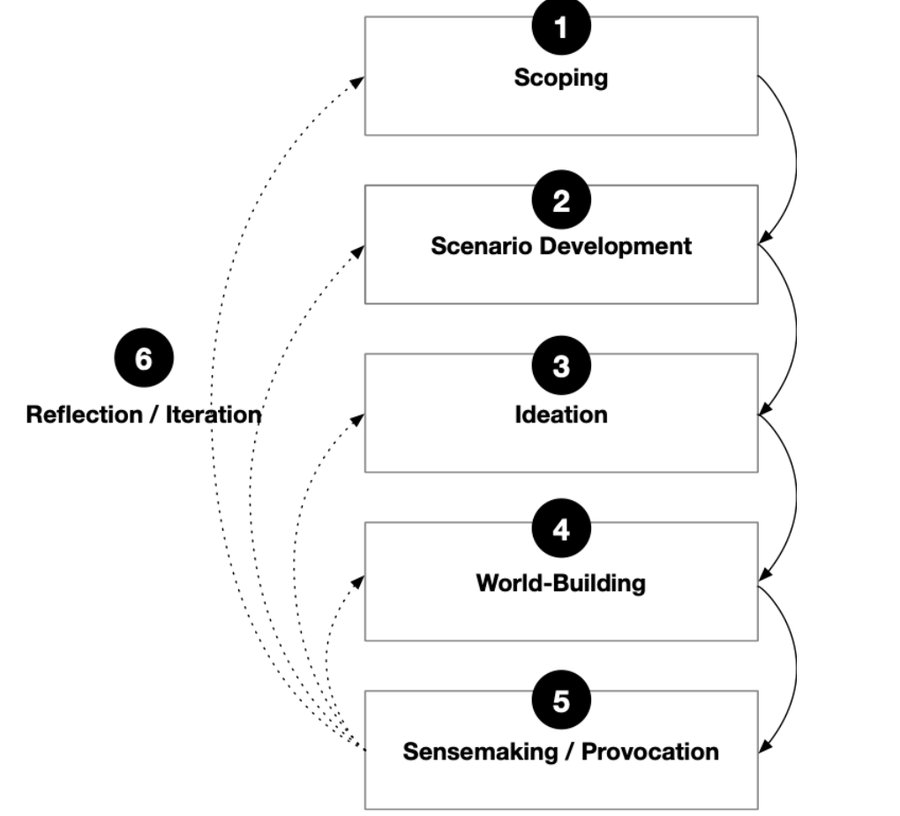
The method has six phases. Scoping sets time horizons, domains and boundary conditions; it stays human-led because it involves normative judgement. In scenario development, generative AI quickly produces varied and speculative futures, while people articulate intent and redirect generation. Ideation develops design ideas within a constructed future rather than for today’s problems. Future world-building makes selected futures tangible as images, animations or artefacts, which act as boundary objects. Provocation and sensemaking uses them, in the spirit of critical design, to surface tensions, values and missing perspectives. Reflection and iteration feeds the insights back into every earlier phase.
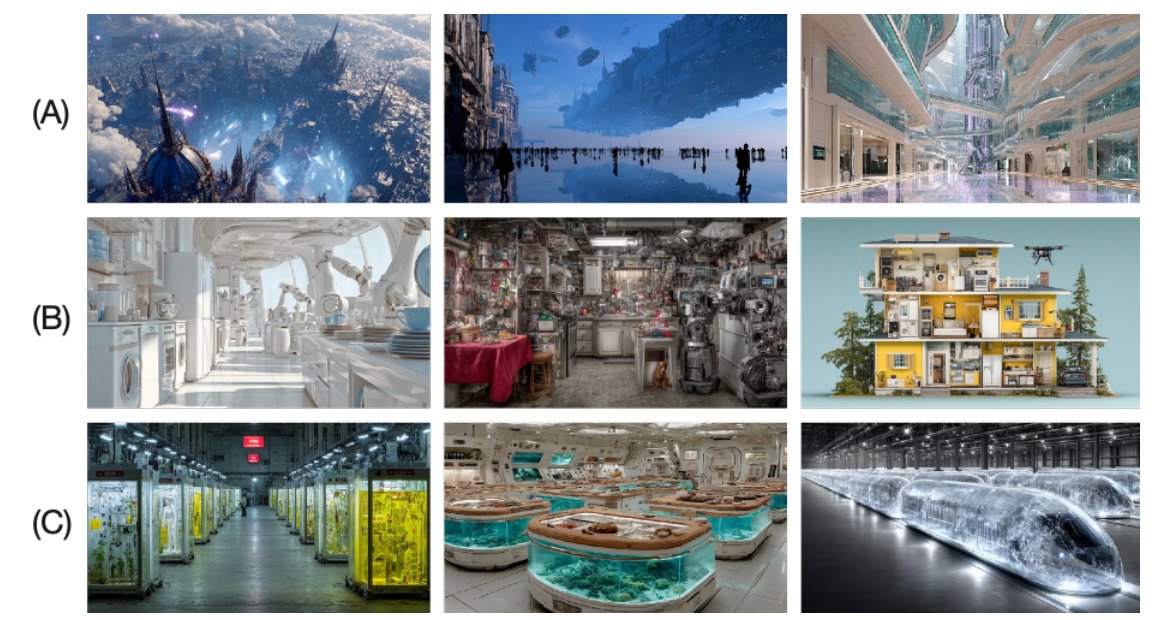
The method was developed over one year in three settings: an IS conference workshop (30 participants), an interdisciplinary master’s course (12) and a master’s course in architecture and design (34). Participants experienced AI as something that “broadened my imagination”, but got better results when they “started with my own ideas”. The images made futures concrete and emotionally engaging, even when they were ambiguous or did not match expectations, and that friction itself started discussions. From these enactments, the paper derives six design principles for human–AI collaboration in futuring:
- Make human intent explicit instead of hiding framing decisions in individual prompts.
- Preserve human authority in normative phases: scoping and reflection stay with people.
- Treat AI generation as provocation, not prescription.
- Situate ideation within constructed future scenarios rather than abstract problem spaces.
- Render futures tangible to enable critical sensemaking.
- Separate generative activity from interpretative sensemaking.
The epistemic foundation for this work is laid out in Fruitfulness in Design Science (DESRIST 2026): future-oriented artefacts are valuable for what they make possible, not only for how well they solve today’s problems.
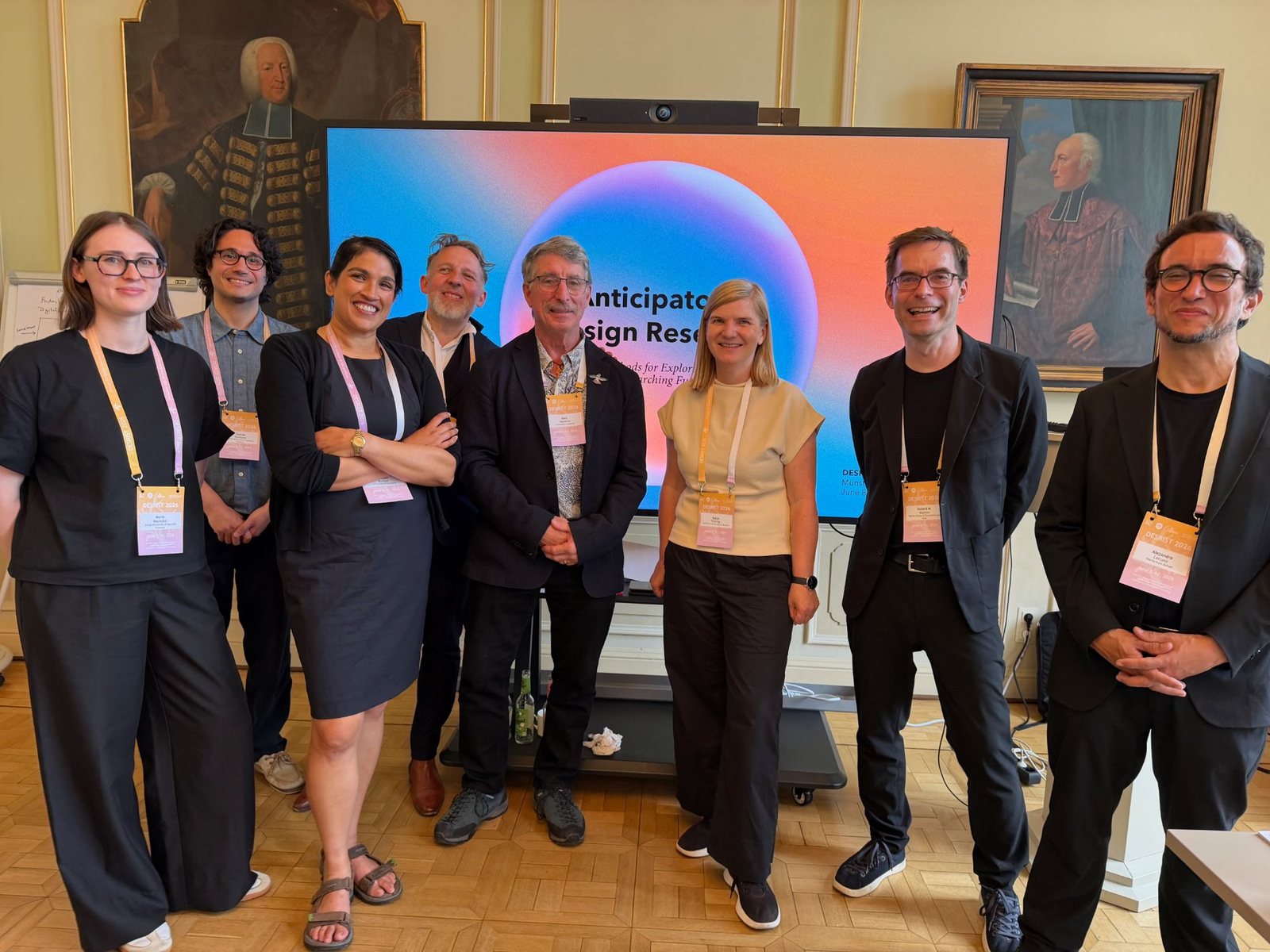
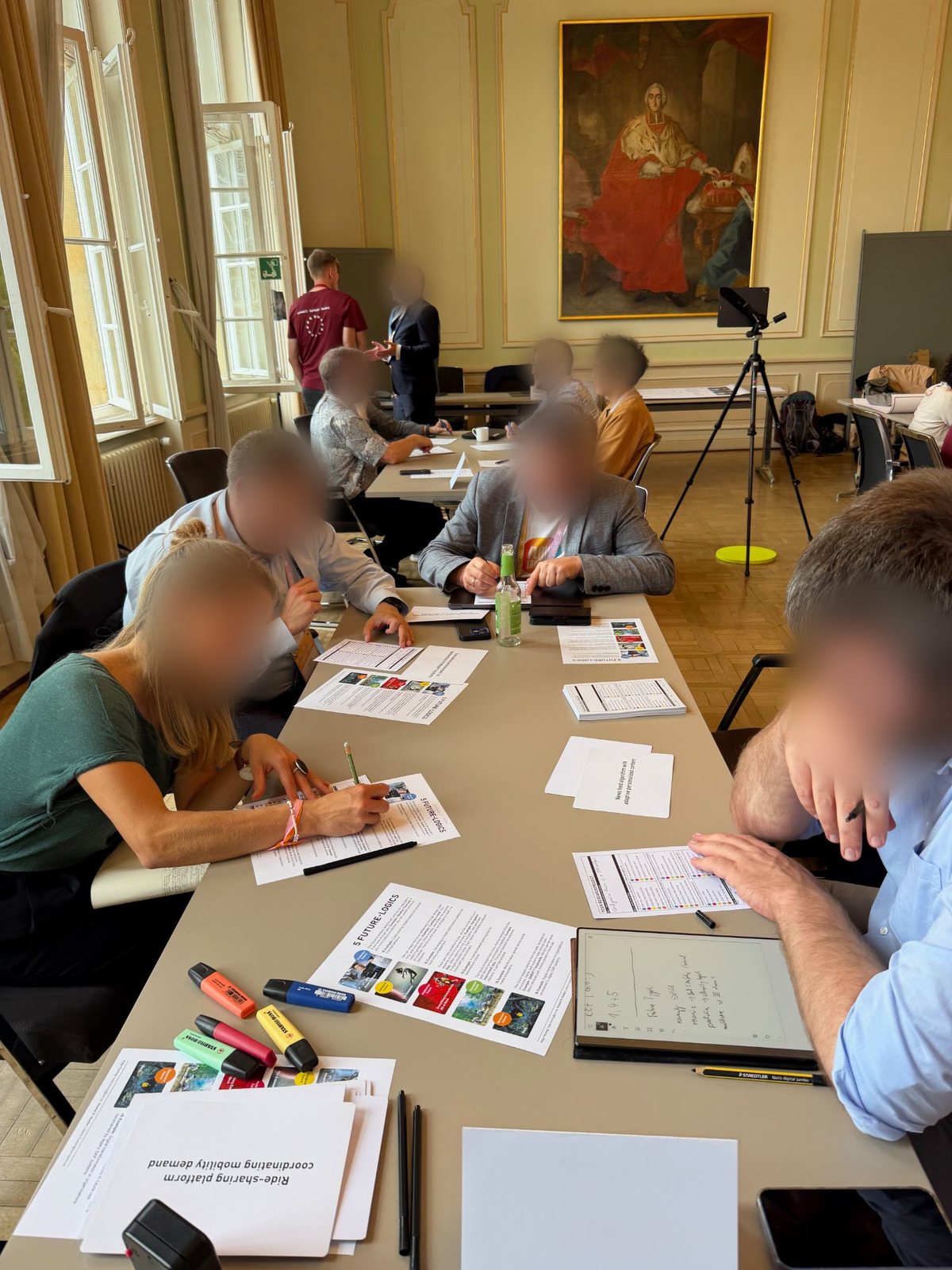
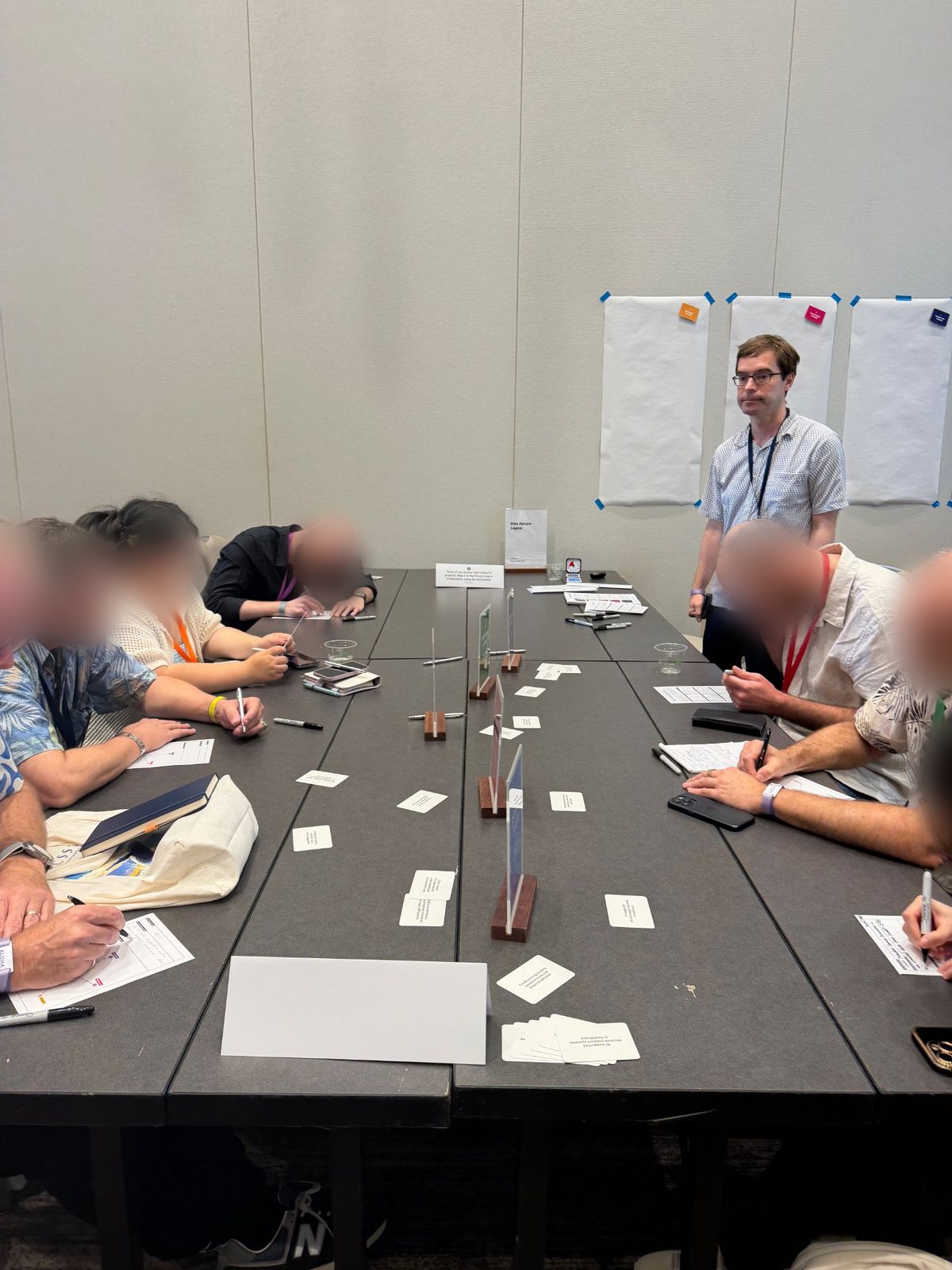
With colleagues, I bring these methods to the community in workshops: Futuring in IS: Methods for Exploring and Researching Futures (HICSS 2026) and Anticipatory Design Research: Methods for Exploring and Researching Futures (DESRIST 2026, Münster). In both workshops, participants worked hands-on with future logics and scenario cards on their own research projects.
- Thoring, Klöckner & Mueller (2022): Designing the Future With the “Delphi Design Sprint”: Introducing a Novel Method for Design Science Research. HICSS 2022 (Best Paper nomination)
- Thoring, Mueller & Klöckner (2023): Mind the Future Gap: Introducing the FOD Framework for Future-Oriented Design. HICSS 2023
- Mueller, Thoring, Klöckner & Larsen (2024): Crafting Future Scenarios with the Help of AI: Potentials of a Hybrid Delphi Expert Panel. HICSS 2024
- Klöckner, Rudzinska, Mueller & Schierding (2025): Futures' Fingerprints: Joint Scenario Assessment via Graspable Boundary Objects in Digital Decision-Making Spaces. HICSS 2025 (Best Paper nomination)
- Rudzinska, Klöckner, Mueller & Schierding (2026): Dialectical AI in Foresight: Advancing Futures Literacy with the Futures' Fingerprints+AI Method. HICSS 2026
- Thoring, Dreyer & Mueller (2027): Prototyping the Future: A Design Science Method for AI-Supported Future World-Building. HICSS 2027 (accepted)
- Related: Fruitfulness in Design Science (DESRIST 2026)