
Fruitfulness in Design Science
Evaluating contributions by what they make possible
Design Science Research (DSR) has traditionally judged contributions by their fitness: how well an artifact solves a specified problem in a given context. That has served the field well. But it offers little guidance for contributions whose main value lies elsewhere: in expanding the space of what can be designed next.
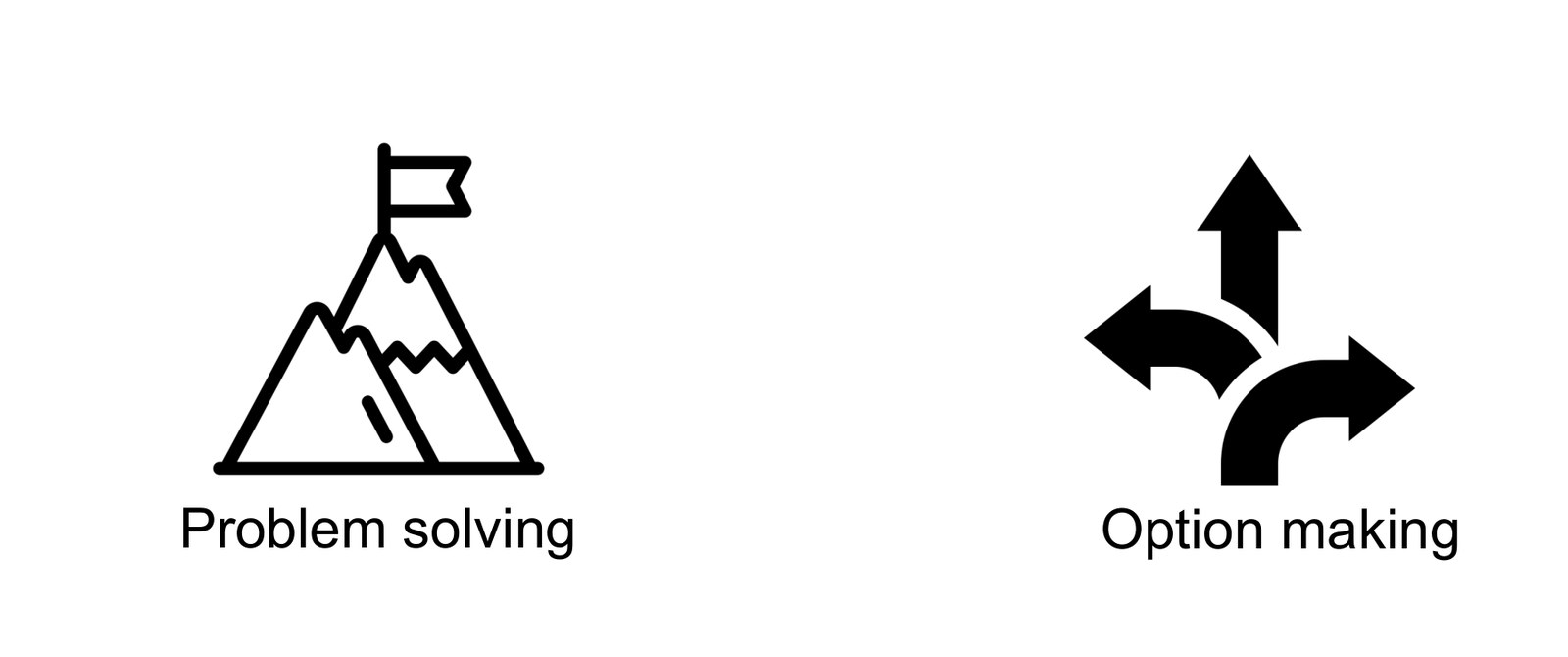
This paper introduces fruitfulness as a complementary evaluation criterion, defined as the capacity of design knowledge to expand or restructure the set of reachable future design states within a structured possibility space. It frames design science as a science of the possible, not only a science of the artificial, and gives anticipatory, speculative and future-oriented design research an epistemic foundation.
A curious artifact
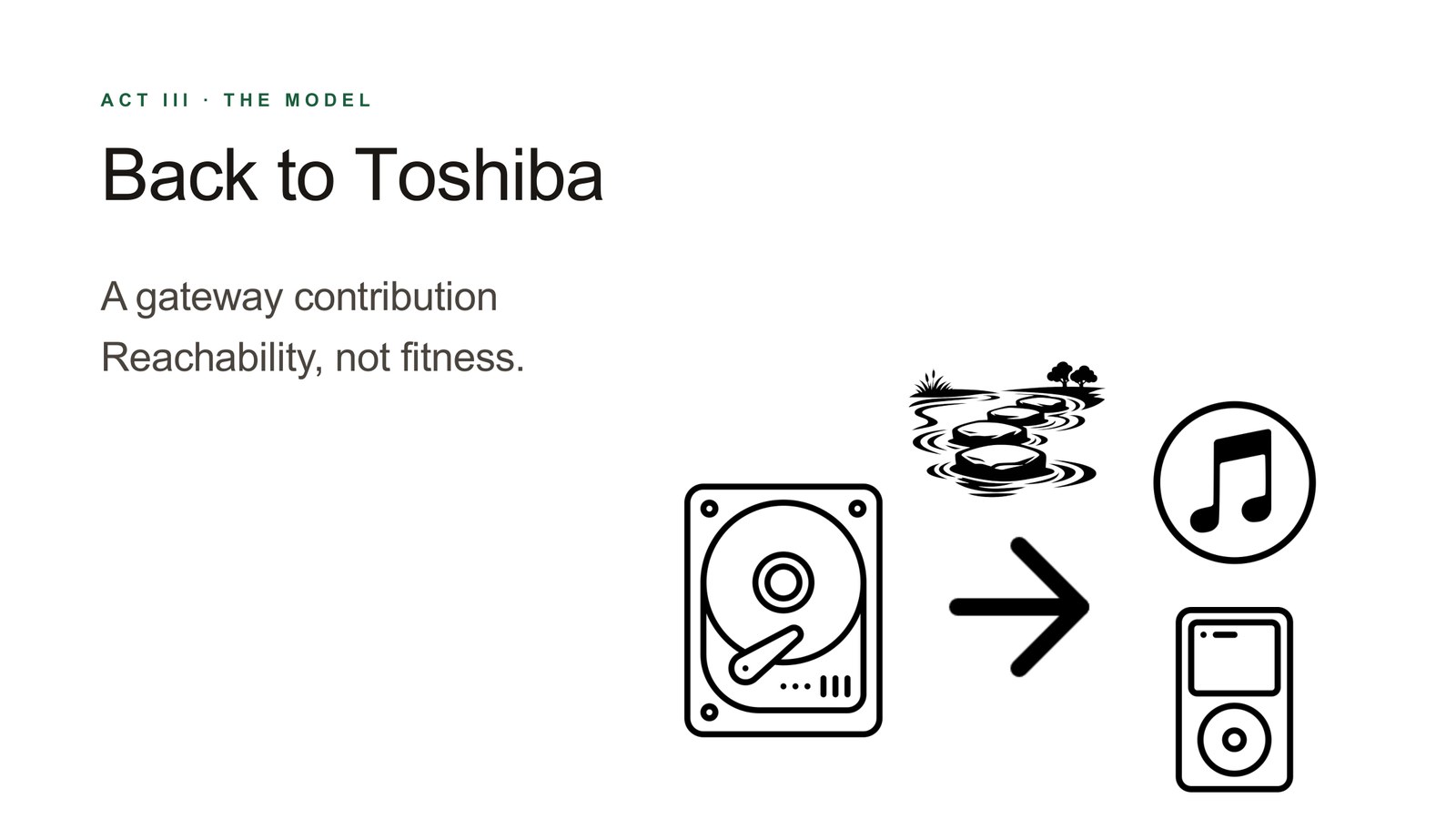
In 2001 Toshiba developed a 1.8-inch hard drive for which its creators had no clear application. On its own the drive had little value. But when Apple’s teams, searching for a better MP3 player, came across it, it removed the trade-off between size, battery life and storage capacity that had stalled their effort. The result was the iPod, and a whole new region of what could be designed for portable music.
Would a review panel have published the drive? Judged by fitness, probably not. Its significance lay in what it made reachable.
Intellectual roots
- Philosophy. Charles S. Peirce contrasted the security of reasoning with its uberty, from Latin ubertas, abundance or fertility. Thomas Kuhn named fruitfulness as one of five criteria for judging scientific theories, alongside accuracy, consistency, scope and simplicity.
- Computer science. Research on non-objective search, such as novelty search, shows that optimising against a fixed objective can be deceptive when progress depends on stepping stones whose value is not visible from the objective.
- Possibility science. David Deutsch’s constructor theory treats statements about what is possible and impossible as fundamental. Stuart Kauffman’s adjacent possible describes how systems evolve by exploring the possibilities reachable from their current state.
Prediction alone cannot generate new possibilities. A perfect “mousetrap oracle” that predicts how many mice each trap will catch still does not tell us how to build a better mousetrap.
Two coupled spaces
The conceptual model treats design science as a collective search through two coupled topographies:
- a fitness landscape, on which material artifacts, instantiated in a context for a problem, are judged by their utility;
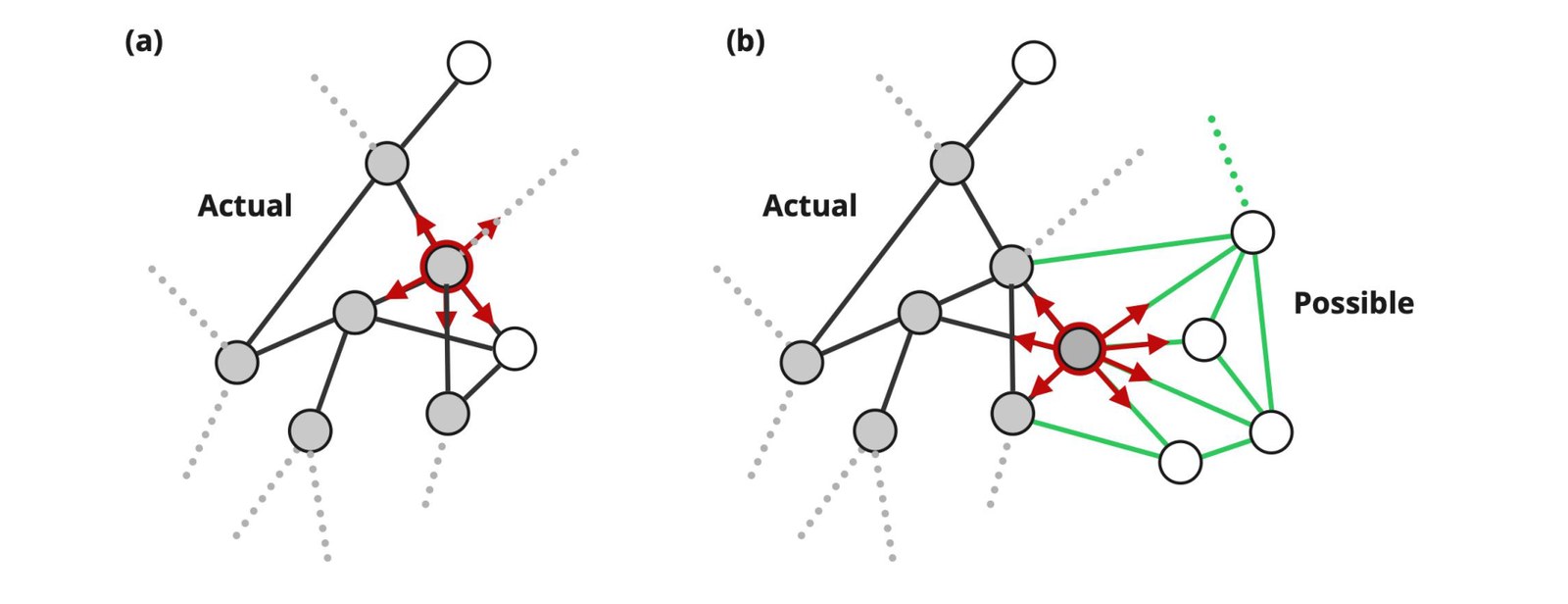
- a possibility lattice, on which abstract design knowledge is structured by prerequisite relations that determine which future design states become reachable, including latent elements not yet realised in any artifact.
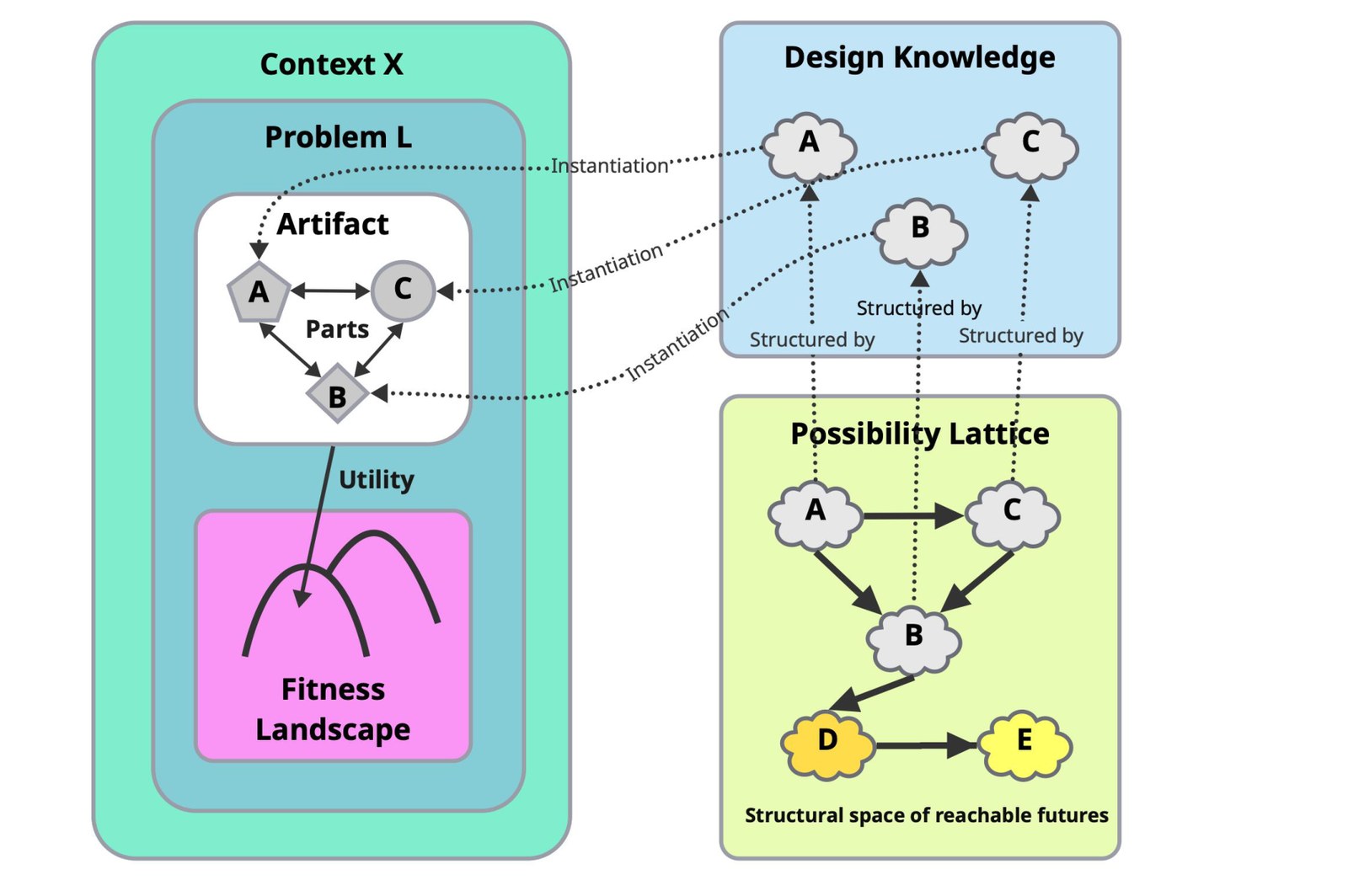
The possibility lattice
In a lattice, a prerequisite relation specifies that a knowledge element becomes reachable only once others are in place. Some possibilities are therefore latent rather than adjacent: they exist in principle but stay inaccessible until their prerequisites are satisfied. Contributions that unlock whole regions act as stepping stones or gateway nodes.
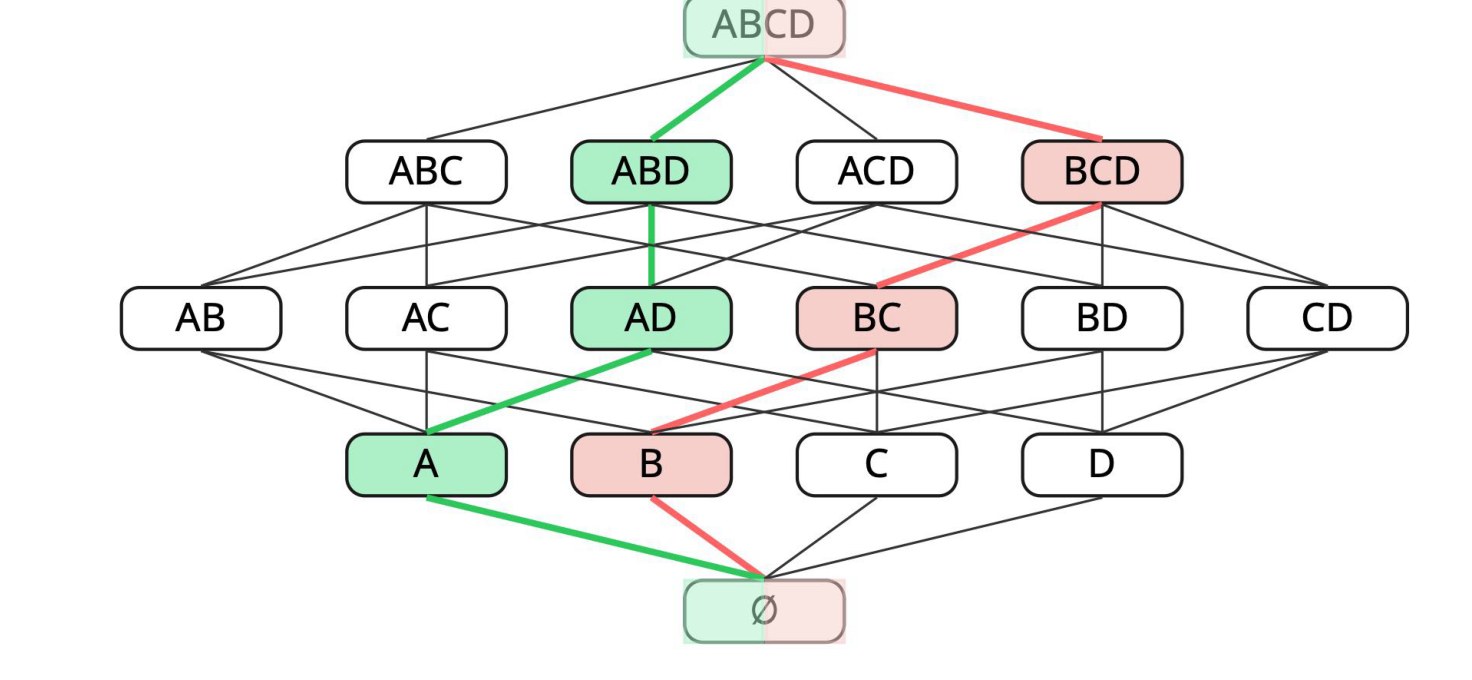
The lattice is path dependent, grows through recombination, and cannot be fully specified in advance: every newly realised possibility reshapes its topology. Fruitfulness is therefore a capacity, not a prediction.
Four artifact types
Artifacts differ in how they engage the possibility lattice, and they deserve different evaluative expectations:
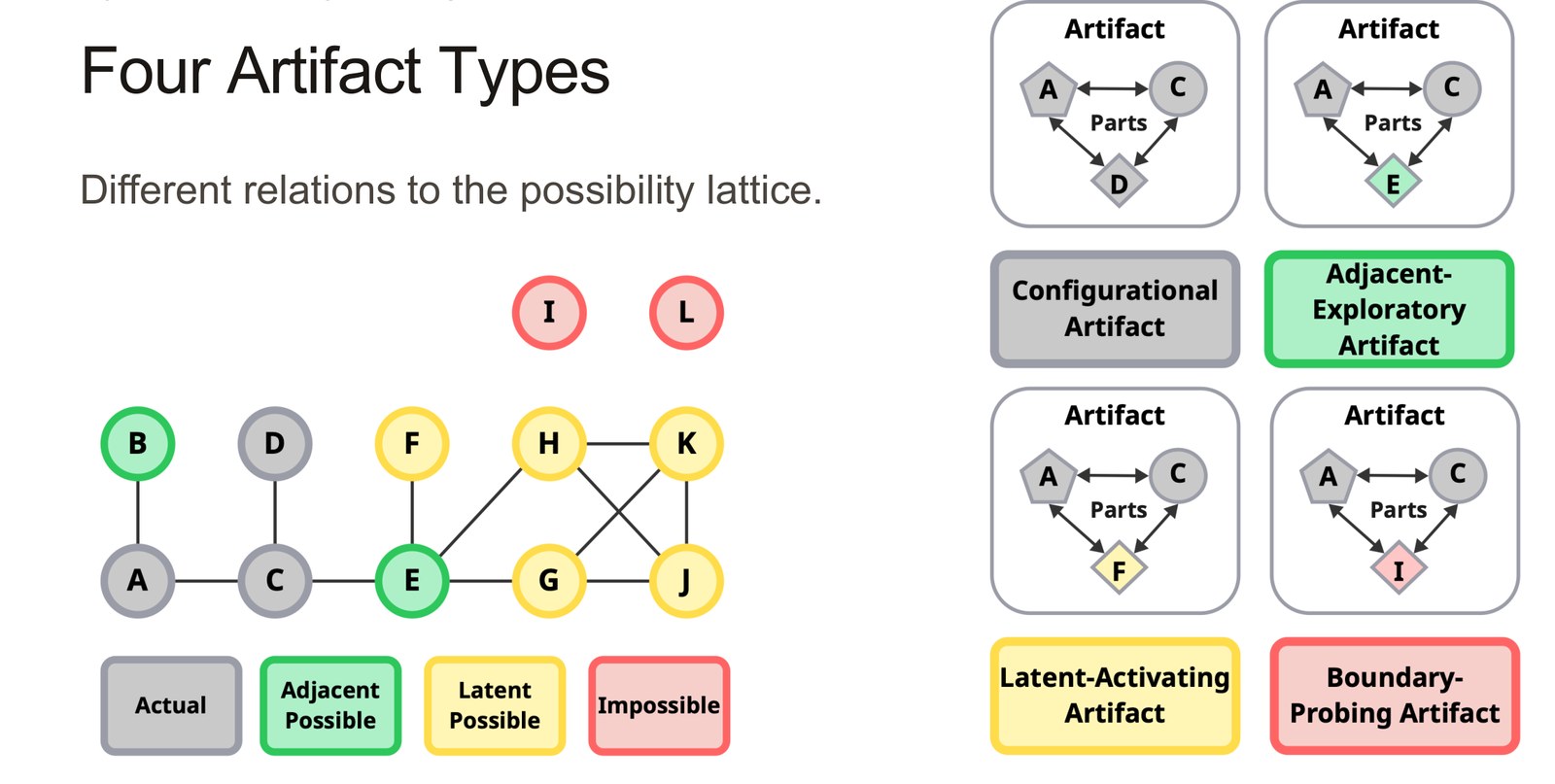
- Configurational artifacts combine knowledge that already exists in a new configuration. Most traditional DSR belongs here; they are judged mainly on fitness, rigour and validity.
- Adjacent-exploratory artifacts instantiate at least one element from the adjacent possible. Example: the RATER system (Pillet et al., MIS Quarterly, 2026) uses transformer models, newly reachable from outside psychometrics, to automate content validation of measurement scales.
- Latent-activating artifacts cannot realise latent knowledge directly but prepare its technical, conceptual or institutional prerequisites. Example: Speculens (Thoring et al., HICSS 2026), an AI-augmented mixed-reality environment for exploring and debating possible futures.
- Boundary-probing artifacts engage with what is impossible, or should remain so, to expose the limits, assumptions and values of the design space. Example: Phygitar, a speculative non-digital planet in 2050 (El Sawy & Rydén, CAIS, 2025).
What fruitfulness is not
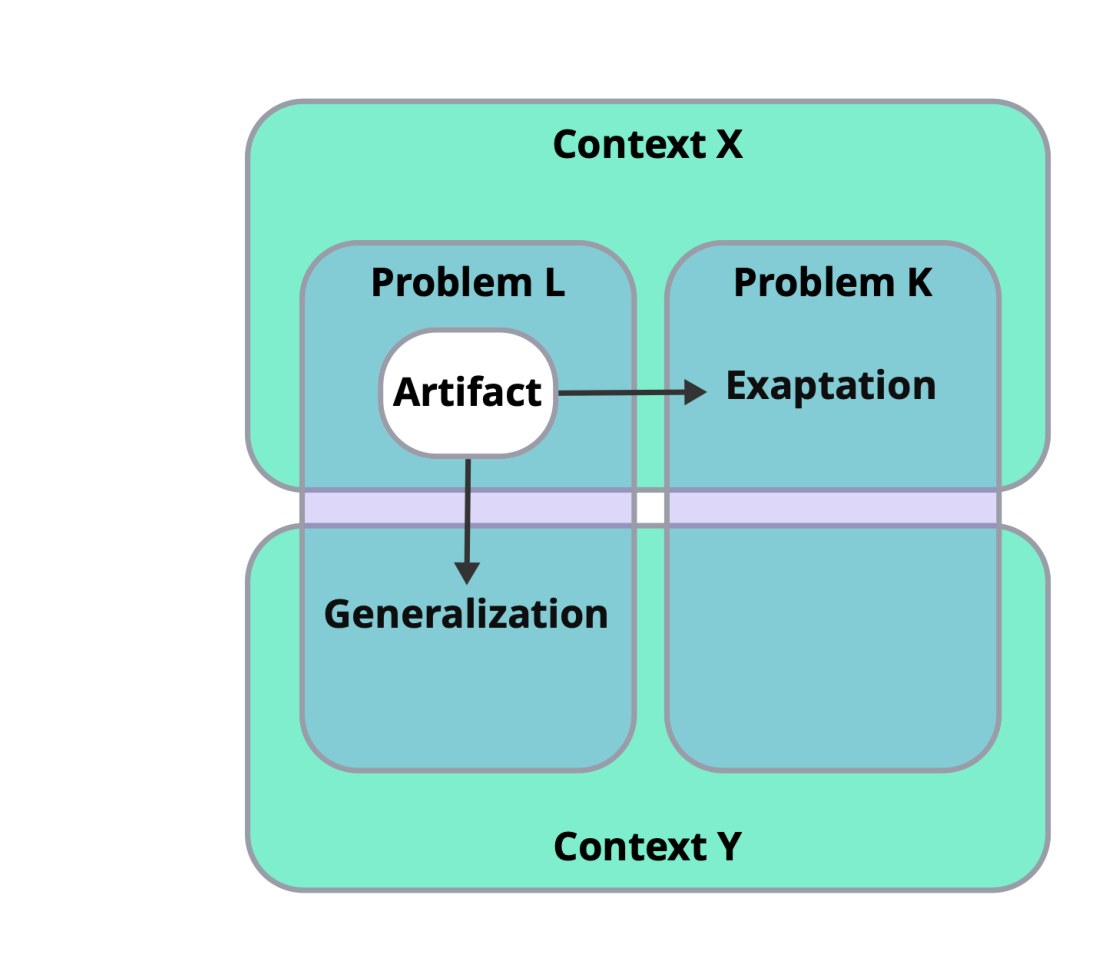
- Not generalization or exaptation. These transfer an existing artifact to another context or problem; fruitfulness concerns how a contribution restructures what can be designed next.
- Not artifact generativity. Generativity concerns how artifacts stay adaptable; fruitfulness evaluates the design knowledge itself.
- Not just basic research. A contribution can be highly fruitful without advancing general theory, and basic research can deepen understanding without expanding what can be built next.
- Not citation counts. Fruitful stepping stones are often cited late, if at all.
- Not “anything goes”. Fruitfulness makes the divergent, generative side of inquiry explicit while keeping it a structured, assessable criterion that complements critical rationalism.
What does this make possible?
The paper proposes guiding questions for authors and reviewers. They are an orienting frame, not a checklist:
- Does the contribution reconfigure existing design knowledge into a novel arrangement that enables solutions not achievable before?
- Does it introduce new conceptual building blocks, components or configurations that others can recombine?
- Does it relax constraints or remove dependencies that previously blocked a class of solutions?
- Does it make a previously inaccessible or unarticulated region of the design space visible or explorable?
- Does it establish technical, conceptual or institutional prerequisites for what can be designed next?
Next steps
- Epistemic simulations: agent-based models of design science communities under fitness-based, fruitfulness-based or hybrid evaluation regimes.
- Extracting fruitfulness claims from the literature with information extraction, building on my work on knowledge extraction.
- Computational proxies that measure how far a contribution expands or diverges from the existing body of design knowledge.
The paper was presented at the 21st International Conference on Design Science Research in Information Systems and Technology (DESRIST 2026) in Münster. It complements Validity in Design Science: validity asks whether a claim about an artifact is justified, while fruitfulness asks what the contribution opens up. It also gives an epistemic foundation to my work on futures methods for design science.